

The short answer is no. Case closed. No further explanation needed.
Not really. If I’m being honest, the answer is more complicated. It’s not a simple yes or no. In fact, the most truthful answer is a resounding maybe.
My Case
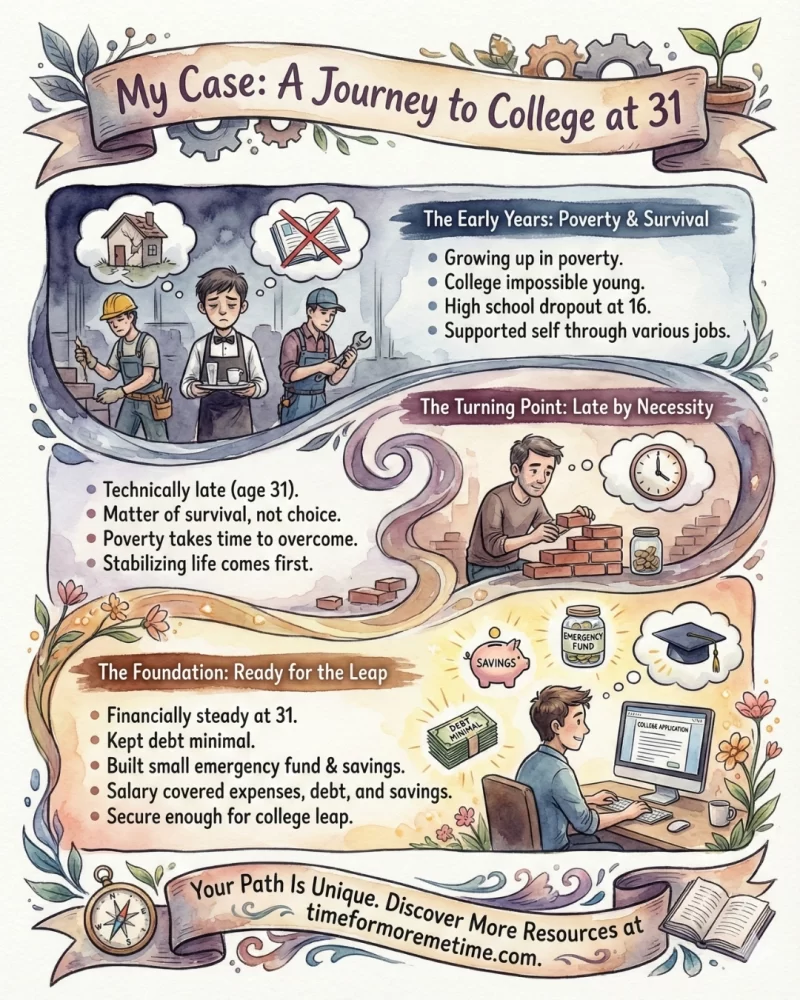
In my own life, I was what many would call a late college student. I didn’t enter college until I was 31 years old. Growing up in poverty made it impossible to consider higher education when I was younger. At 16, I dropped out of high school. By the time I reached my 20s, college still wasn’t an option, even though I had managed to support myself through various jobs.
So, did I go to college too late? Technically, yes. But being late was a matter of survival. Poverty isn’t something you can overcome in a year or two. It takes time to stabilize your life enough to make education possible.
For me, that stability finally came at age 31. By then, I had managed to get financially steady. I had kept my debt minimal, built up a very small emergency fund, and started putting away savings. My salary was just enough to cover living expenses, chip away at debts, and keep adding to my safety net. Only then did I feel secure enough to take the leap into college.
My Experience
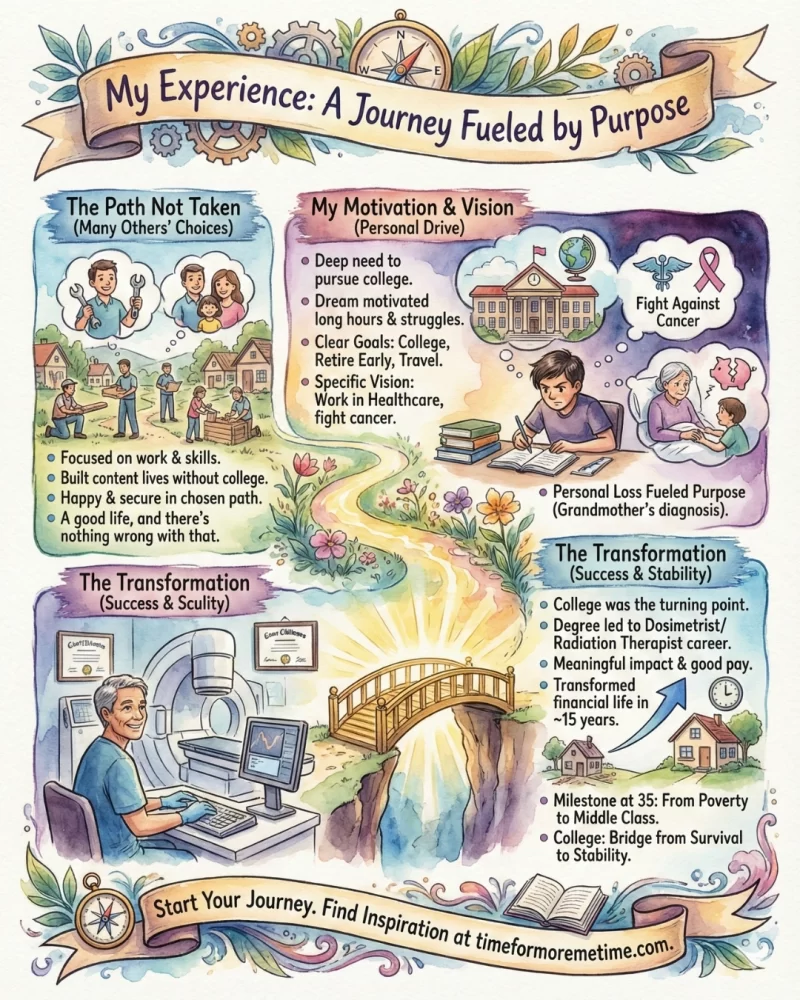
For many people I knew who shared a similar background, college never became part of their story. Most of them chose to focus on work, became confident in their skills, and built a life they were content with. And I’ll say this—there’s nothing wrong with that. If someone is happy and secure in their chosen path, that’s a good life.
But in my case, I felt a deep need to pursue college. For decades, the dream of higher education was what kept me motivated to work long hours and push through financial struggles. My goals were clear: get into college, retire early, and travel. More than that, I had a specific vision—I wanted to work in healthcare and contribute to the fight against cancer.
That desire was personal. My grandmother was diagnosed with cancer, and one of my deepest regrets is that no one in my family had the medical knowledge or connections to help her. We were dirt poor, with no access to doctors or hospitals beyond what we could barely afford. That loss fueled me. It gave me purpose.
Fast forward to today, and college was the turning point that made everything possible. Earning my degree allowed me to enter the healthcare field and become a dosimetrist—a career that pays very well and carries meaningful impact. Even though I started late, it took just a decade and a half to completely transform my financial life.
By 35, after graduating and passing my licensing exam, I became a radiation therapist. That single milestone pulled me out of poverty and firmly into the middle class. College for me was the bridge between a life of survival and a life of stability.
My Considerations
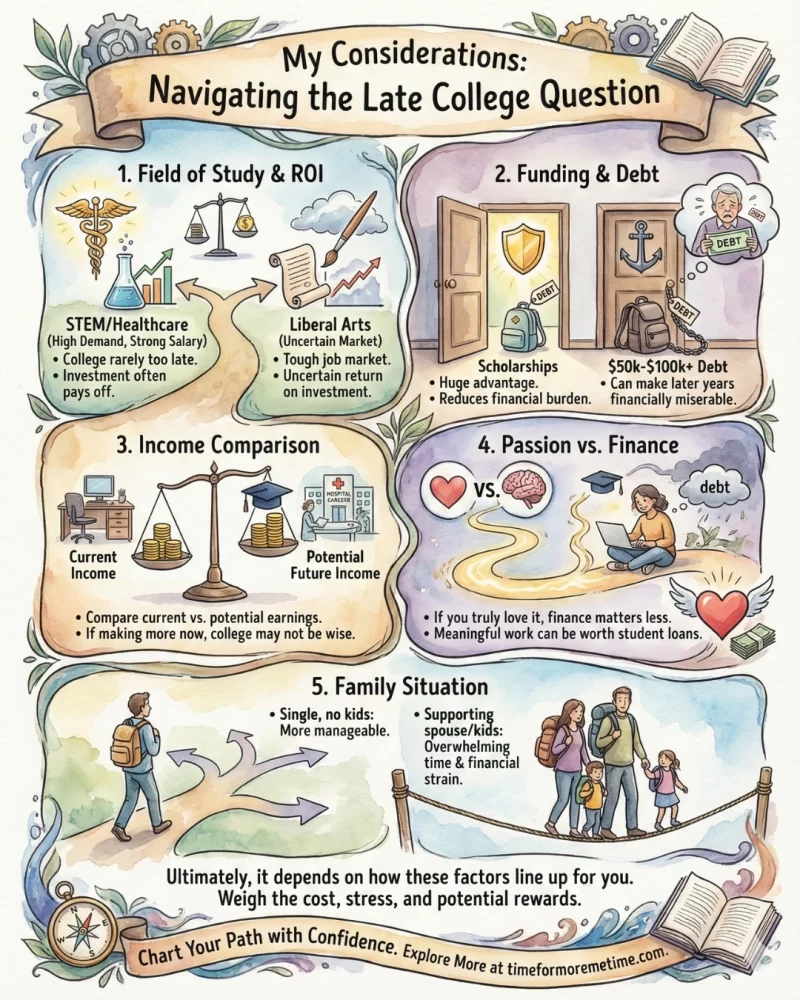
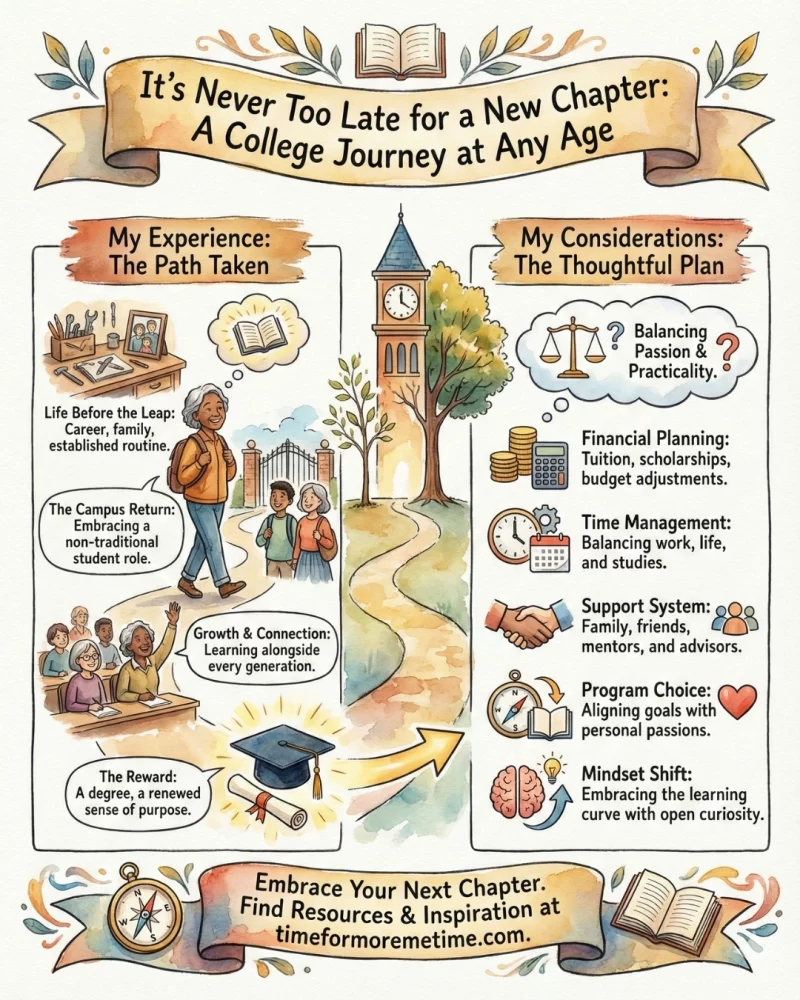
So, is it ever too late to get into college? As I said earlier—maybe. The answer depends heavily on your circumstances, your goals, and your chosen career path.
First, consider your field of study. If you’re aiming for a career in healthcare or another STEM-related field where demand is high and salaries are strong, then college is rarely too late. The investment can pay off quickly. But if you’re considering a liberal arts degree at an older age, the job market can be tough and the return on investment uncertain.
Second, factor in how you’ll pay for it. Scholarships are a huge advantage, and if you have the ability to earn them, you can greatly reduce your financial burden. But if you expect to graduate later in life saddled with $50,000 or even $100,000 in student debt, that can make your later years financially miserable.
Third, compare your current income with your potential earnings after graduation. If you’re already making more now than you’re likely to in your new career, then pursuing college may not be the wisest choice.
Fourth, think about passion. If you truly love a certain career path, then the financial considerations may matter less. Even if you graduate late and spend decades paying down student loans, pursuing work that gives your life meaning can still be worthwhile.
Fifth, consider your family situation. If you’re single and don’t have children, going back to college is far more manageable. If you’re supporting a spouse or kids, the time and financial strain can be overwhelming—not just for you, but for them too.
Ultimately, whether it’s too late to go to college depends on how these factors line up for you. For some, it’s the smartest move they’ll ever make. For others, it may not be worth the cost or stress.
Conclusion
In my case, all the pieces aligned. I chose a career path with high demand and strong pay. I believed in myself enough to know I could graduate and pass my licensing exams. I was earning less before than I could as a dosimetrist, so the financial jump made sense. I was driven by my grandmother’s battle with cancer, and I had no family obligations holding me back.
Even though I didn’t start college until my early thirties, the decision was absolutely worth it. I graduated, became licensed, and paid off more than $100,000 in student debt. Today, I stand on solid financial ground, with a career I love and the stability I once only dreamed of.
So, if you’re past your twenties and wondering whether college is still worth pursuing, weigh your options carefully. Look at your field, your finances, your responsibilities, and your motivations. If the conditions are right, it’s never too late.
This is another personal post of mine. I missed actually writing an actual blog post. Anyway, if you like this type of content, please tell me. And as usual, follow me on my socials, subscribe in my newsletter, and check out my YouTube channel. See you there!
Source
- Photo: Unsplash: Dom Fou