

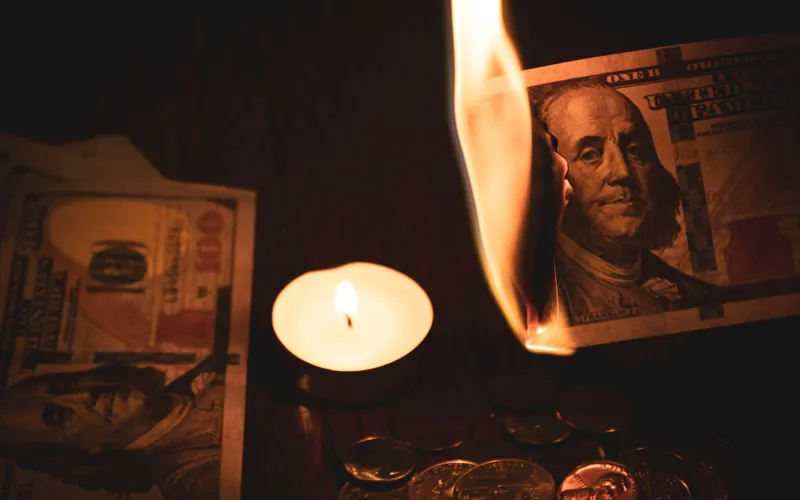
As someone who often talks about finance and the journey from poverty to financial stability, I think it’s important to address an age-old question: Is money the root of evil? It’s a phrase that has been repeated for centuries, echoing through literature, religion, and even casual conversation.
For those who don’t know, the phrase itself is often misquoted from the Bible. The verse actually says, “The love of money is the root of all kinds of evil.” Yet most people shorten it and say, “money is the root of evil.” When read, it’s clear as day. Greed is the root of evil, money itself is not.
So, from my perspective, the answer is simple: no, money is not the root of evil. Money is just a tool. It does not carry morality on its own. Just like a hammer can be used to build a house or harm someone, money can be used to create opportunities or to exploit others. The tool itself is neutral; the person wielding it determines whether it leads to good or bad outcomes.
Why Money Gets A Bad Reputation
When I was a child, I knew firsthand what it meant to have no money. There were days when my family went without food—days when hunger gnawed at us not just physically but emotionally. Outwardly, I tried to smile and play with my friends to distract myself. But deep down, the anxiety never left me. Hunger has a way of etching itself into your memory.
Because of that, I grew up associating money not with evil, but with survival. To a poor child, money is his lifeline. Yet the world often sees it differently, portraying money in a darker, more sensational light.
Throughout history, money has carried a bad reputation because of the stories we tell about it. From ancient myths to modern films, money—or more accurately, the greed for it—is frequently cast as the villain.
Think of corrupt kings who hoard wealth while their people starve. Think of dishonest businesspeople who exploit workers for profit, or real-life scandals where leaders embezzle funds. These narratives are compelling and easy to grasp, which is why writers and filmmakers continue to recycle them.
But the truth is more complicated. Money itself doesn’t corrupt anyone—it simply reflects human choices. People decide whether to use money to build or to exploit, to heal or to harm.
Yet because money is such a convenient scapegoat, it often takes the blame for human failings. After all, money can’t argue back or defend itself.
And unfortunately, the media and literature reinforce this idea because the phrase “money is the root of evil” is simple, catchy, and memorable. It offers a clear moral, even if it oversimplifies reality.
Money As A Modern Tool
In today’s world, money isn’t even something you always hold in your hand. It exists mostly in digital form, flashing as numbers on a screen or stored as data in a bank’s server.
When you get paid, you don’t receive a sack of coins or an envelope full of cash. It’s just digits added to your account. When you spend, those digits decrease. You might swipe a card, tap your phone, or transfer online, but rarely do you hold the physical bills.
Because money is now so abstract, it’s even easier to misunderstand it. At its core, money is simply a record of trust.
When you deposit $100 into a bank, the institution records that you have $100 under your name. If you owe $200, the system shows that your balance is -$100. But what does that even mean? How can you own less than zero? But yeah, that’s debt.
This is proof that money isn’t real in the way people often think. It’s a ledger of agreements, trust, and obligations.
And trust me, when you grow up poor, this truth hits harder. If your reputation, your name, or your credit is damaged, you can lose access to money entirely—even if you’ve worked hard for it. You can even lose your children, just like what happened to my family when I was still a kid.
That’s why protecting your name is so important. Your money is tied to your credibility, and if others stop trusting you, your financial security evaporates.
Money And Morality
So where does evil come into the picture?
Let’s be clear: it reveals character. It really doesn’t create evil. If someone is greedy, selfish, or corrupt, money amplifies those traits. If someone is generous, disciplined, and compassionate, money amplifies those as well. Money magnifies who you already are.
When I was 31, after years of working various jobs just to survive, I finally enrolled in college. It wasn’t easy. That choice required money. Tuition, books, transportation—it all added up. I had to carefully budget and even take on debt, something that scared me deeply after a childhood of scarcity. But I saw that money, properly managed, wasn’t evil—it was the bridge between where I was and where I needed to be.
Years later, when I became a radiation therapist and eventually a dosimetrist, money gave me stability I never imagined possible. It lifted me from the poverty line into the middle class. It gave me the ability to help family, to save, to travel, and to live without the constant gnawing anxiety of hunger. That doesn’t sound like evil to me. That sounds like freedom.
The Dangers Of Loving Money Too Much
While money itself is neutral, the love of money—chasing it at all costs—can be destructive. I saw this growing up. Many people in my neighborhood, stuck in poverty like us, dreamed of escaping by getting rich quick. Some turned to gambling, others to shady deals, and a few even got into crime. They weren’t bad people at their core; they were desperate. They thought money alone would solve every problem.
But obsession with money can blind you. You stop seeing money as a tool and start treating it as your identity. And when that happens, you can lose yourself.
I nearly fell into that trap myself. In my twenties, I worked job after job, often multiple at once, thinking that hustling harder would finally erase my financial anxiety. But even when I had a little cushion, I still felt the old fear—that hunger, that worry. It wasn’t until I shifted my mindset that things began to change. I realized money could help me build a better life, but it couldn’t define who I was or how I measured my worth.
Money As Opportunity
One of the best ways to understand money is to see it as a door-opener. Money doesn’t guarantee happiness, but it creates options.
Take education as an example. If I hadn’t gotten myself to a place of modest financial stability by my early thirties, I never would have made it into college. That single decision reshaped my entire life. My degree in radiation therapy gave me entry into healthcare, and later training as a dosimetrist opened up even greater financial stability. That opportunity was only possible because I used money wisely—not to buy luxuries, but to invest in myself.
Think about something as simple as buying a lottery ticket. It doesn’t guarantee you’ll win, but without a ticket, you have no chance at all. Money is like that; it only gives you access to opportunities. The more wisely you use it, the more doors it can open.
What Money Cannot Buy
Still, it’s important to remember that money has limits. It can buy comfort, security, and even fleeting happiness. But not everything meaningful.
As a child, I sometimes thought, “If only we had money, we’d never fight, we’d never worry.” But now I know that’s not true. Money eases stress, yes, but it doesn’t replace love, loyalty, or genuine happiness.
You can buy a scoop of ice cream and enjoy the moment. You can buy a plane ticket and explore the world. You can even buy more time in some ways like paying for convenience, help, or healthcare. But you cannot buy love, nor can you buy inner peace.
This became clear to me after I graduated, passed my board exam, and finally started earning a good salary as a radiation therapist. For the first time in my life, I wasn’t worried about rent or food. But even then, I realized that my happiness still came from relationships, from a sense of purpose, and from personal growth—not from the digits in my bank account.
Money As A Mirror
So, if money isn’t the root of evil, what is it?
I’d say money is a mirror, as I insinuated in the previous sections. It reflects back the values, intentions, and character of the person holding it.
If someone is greedy, dishonest, or selfish, money will magnify that side of them. If someone is kind, generous, and disciplined, money magnifies those qualities as well. Money shows the world who you’ve been all along. It doesn’t really change you or turn you evil. Money just gives you the opportunity and potential freedom to show your true colors.
For me, money has been both a test and a teacher. It tested me when I had none, forcing me to build resilience, resourcefulness, and patience. And it taught me that when I finally had enough, my responsibility was to use money wisely—to help others and to live in alignment with my values.
Conclusion
So, is money the root of evil? Absolutely not. Money is simply a tool—powerful, yes, but neutral in itself. What matters is how we approach it, how we use it, and whether we allow it to define us.
Growing up poor taught me that money is survival. Going to college late taught me that money is opportunity. Working in healthcare taught me that money can mean access to life-saving treatment. And building a solid financial life taught me that money can be freedom—freedom from fear, from hunger, from instability.
But I also know this: chasing money without balance can destroy you. It can lead to broken relationships, sleepless nights, and endless dissatisfaction. That’s why the healthiest perspective is to see money as it really is—not as a god to worship, not as a demon to fear, but as a mirror that reflects the choices you make.
In the end, money will not decide who you are. But what you choose to do with money will.
If you like this kind of posts, well, tell me. Subscribe to my newsletter, follow my socials, and check out my YouTube channel. See you there!
Source
- Photo: Unsplash: Gabriel Meinert