

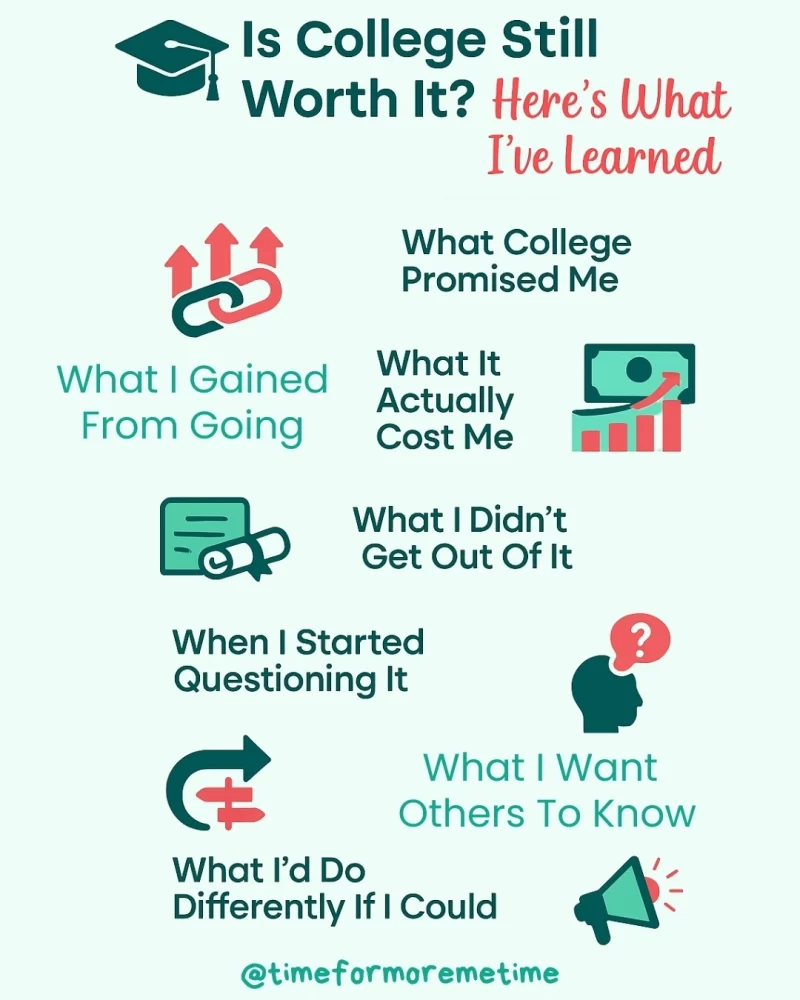
Despite dropping out of school at 16, I eventually became a dosimetrist and earned three college degrees—including one in business and another in radiologic technology. But the road wasn’t straightforward, and looking back, my experience with college taught me a lot more than what was in the textbooks. If you’re wondering whether college is still worth it, here’s what I’ve personally learned. Let’s get started!
What College Promised Me
Growing up, college was painted as the golden ticket. I heard it from teachers, relatives, and every career counselor: Get a degree, and you’ll be set.
I believed it. I thought college would launch me into a stable, well-paying job, offer clear direction, and make up for the years I lost after dropping out.
There was a lot of pressure to catch up. I didn’t just want to finish school—I needed to prove something to myself and others. For someone with an unconventional start, college seemed like the only path that could legitimize my success. So I went all in.
What It Actually Cost Me
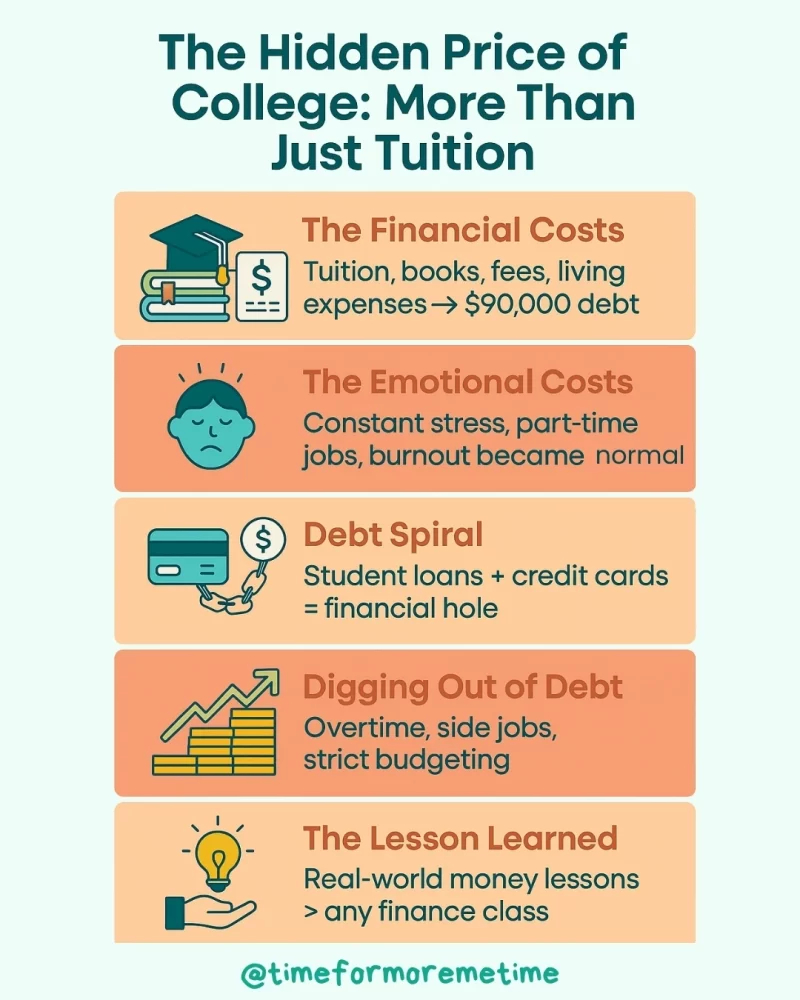
What I didn’t realize back then was just how expensive “the dream” would be. Between tuition, books, lab fees, uniforms, and clinicals—not to mention food, rent, and transportation—I racked up costs quickly. Even with scholarships and financial aid, student loans became a reality I couldn’t escape.
But it wasn’t just the money. The emotional cost hit just as hard. I dealt with constant stress, balancing school with part-time work, and living with the pressure to prove I belonged. Burnout became normal. Some nights, I questioned whether I had made the right call.
On top of student loans, I relied on credit cards to make ends meet—buying groceries, paying bills, and covering gas when cash ran out. It added up fast. By the time I graduated, I was staring at nearly $90,000 in combined debt.
It took years of discipline to dig out of that hole. I budgeted aggressively, worked overtime, picked up side jobs, and funneled every extra dollar toward paying off my debt. I used a mix of debt snowball and avalanche strategies—paying off smaller balances for quick wins while tackling high-interest loans as I gained momentum.
It wasn’t easy, but slowly, I cleared every balance. That chapter taught me more about money than any finance class ever could.
What I Gained From Going
Still, there were real wins. College gave me more than just a diploma—it gave me discipline. I learned how to stay organized, communicate clearly, handle pressure, and manage my time.
Those skills became essential once I entered the healthcare field, especially in my current role as a dosimetrist. Even now, critical thinking and clear documentation—things I sharpened in school—help me every single day.
College also gave me community. I met people in study groups, labs, and clinicals who pushed me to grow, both personally and professionally. Some of those relationships are still in my life today.
And while my journey wasn’t linear, the feeling of finishing what I started—especially after dropping out at 16—gave me a sense of pride I still carry with me.
What I Didn’t Get Out Of It
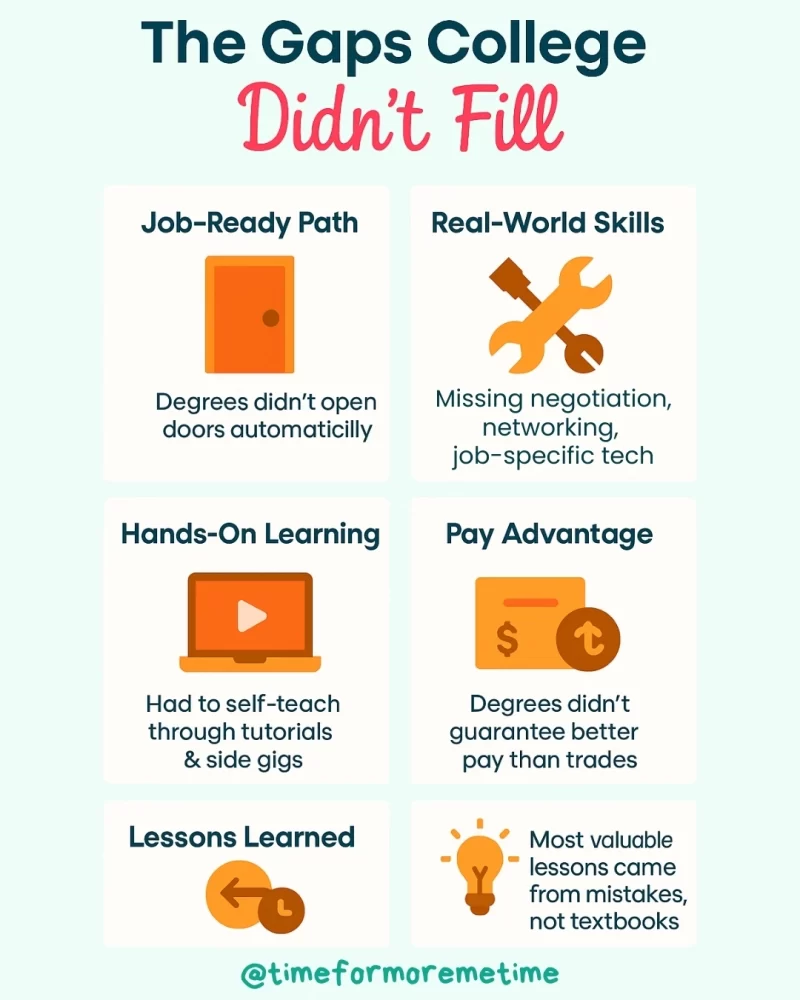
But I’d be lying if I said the transition from graduation to employment was smooth. The degrees didn’t automatically open doors. I still had to grind—applying to dozens of jobs, hearing no more often than yes, and realizing that even with credentials, I wasn’t fully prepared for the workforce.
Many of the skills I needed—like negotiation, networking, and even job-specific tech—weren’t covered in class. I had to teach myself through YouTube tutorials, trial and error, and side gigs just to stay competitive.
Some of my most valuable professional lessons didn’t come from a textbook—they came from making mistakes and learning fast.
And while degrees looked good on paper, they didn’t guarantee better pay right away. I’ve met plenty of people who earned more with certificates or trade licenses than I did in my early post-college years. That reality was humbling.
When I Started Questioning It
The doubts really started creeping in when I saw friends who skipped college building solid careers. Some went into trades—plumbing, HVAC, electrical work—and were making a stable income with no student debt, sometimes within 18 months. Others took online courses or jumped into freelance work and built profitable side hustles faster than I could finish a semester.
I couldn’t help but wonder: Did I take the longer—and more expensive—route?
Watching people in their early twenties pull in more than I while I was juggling student loan payments made me pause. That comparison was hard to ignore, especially when I was still digging my way out of $90,000 in debt.
Even though I now make over $270,000 a year, it took a lot of uphill work to get here. The payoff didn’t come quickly, and there were moments when I wasn’t sure it ever would.
What I’d Do Differently If I Could
Would I still go to college? Yes—but I’d do it with a different mindset.
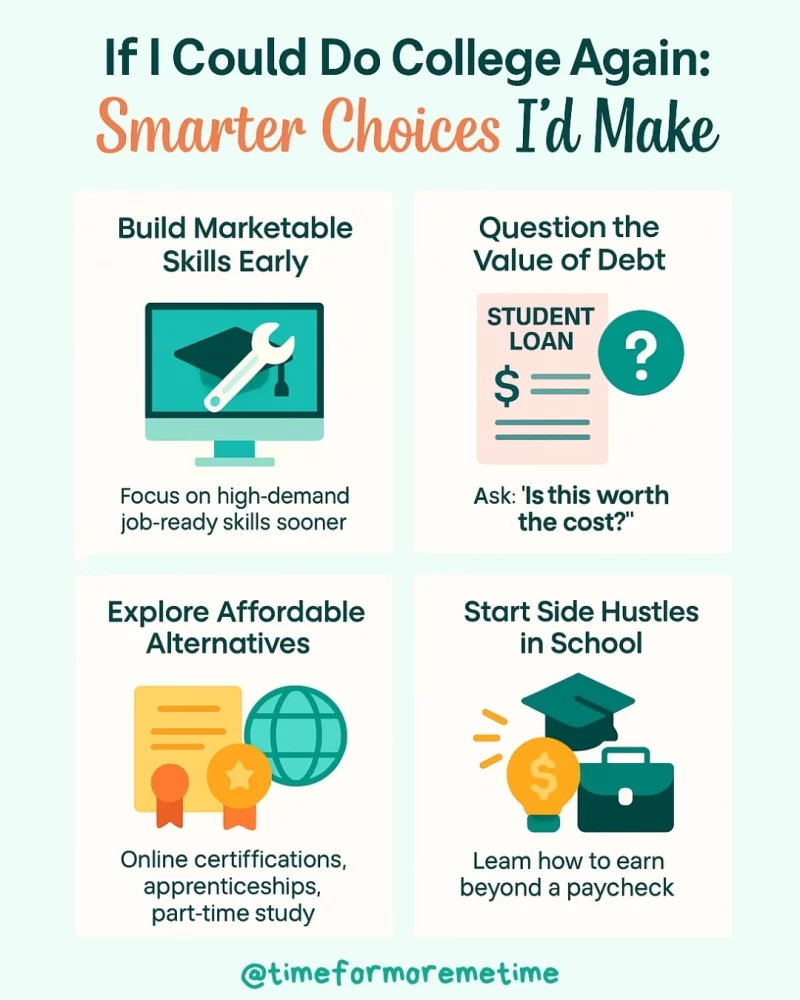
If I could go back, I’d focus on building marketable, high-demand skills earlier instead of chasing degrees for the sake of having them. I’d ask more questions: “Is this worth the debt? Will this degree truly move me forward?”
I’d also explore alternatives like online certifications, gig work, apprenticeships, or part-time schooling paired with real-world experience. These options aren’t just cheaper—they often get you earning sooner.
If I had started there, I could’ve built a foundation faster and paid off my debt years earlier. And I definitely would’ve started side hustles while still in school.
Even if they weren’t massive income sources, they would’ve taught me how to make money outside a paycheck—and that’s a skill no degree can guarantee.
What I Want Others To Know
College isn’t a scam—but it’s not a shortcut either. It works for some paths, but not all. What matters most is alignment. If a degree truly supports your long-term goals, then go for it—just go in with your eyes open, not just because it feels like the “right” thing to do.
You don’t need to follow the default path to build a good life. What worked for your parents or teachers may not work for you.
Question it. Explore. Pivot. There’s no shame in taking a different route—as long as it gets you where you want to go.
Conclusion
College gave me structure and skills, but it didn’t guarantee success. I had to work, adapt, and pay off $90,000 in debt to reach where I am now—earning over $270,000 a year as a dosimetrist.
If this post gave you a new way to think about college, subscribe to the blog, follow us on social media, and check out our YouTube channel.
Sources
- Photo: Pexels: Gül Işık