
With the constant demands of work, social commitments, and family life, it’s easy to feel overwhelmed. However, organized people manage to balance these aspects effectively, making the most of each day.
I am a testament to the benefits of being organized. Without it, I’m sure I wouldn’t be where I am today. Just imagine juggling multiple jobs while running a website, managing social media accounts, and maintaining a YouTube channel—all while overseeing employees. It’s a lot, I tell you!
If I weren’t organized, my career, blog, and personal life would likely fall apart. But if that’s not enough to convince you to get organized, let me share some of the benefits. Let’s get started!
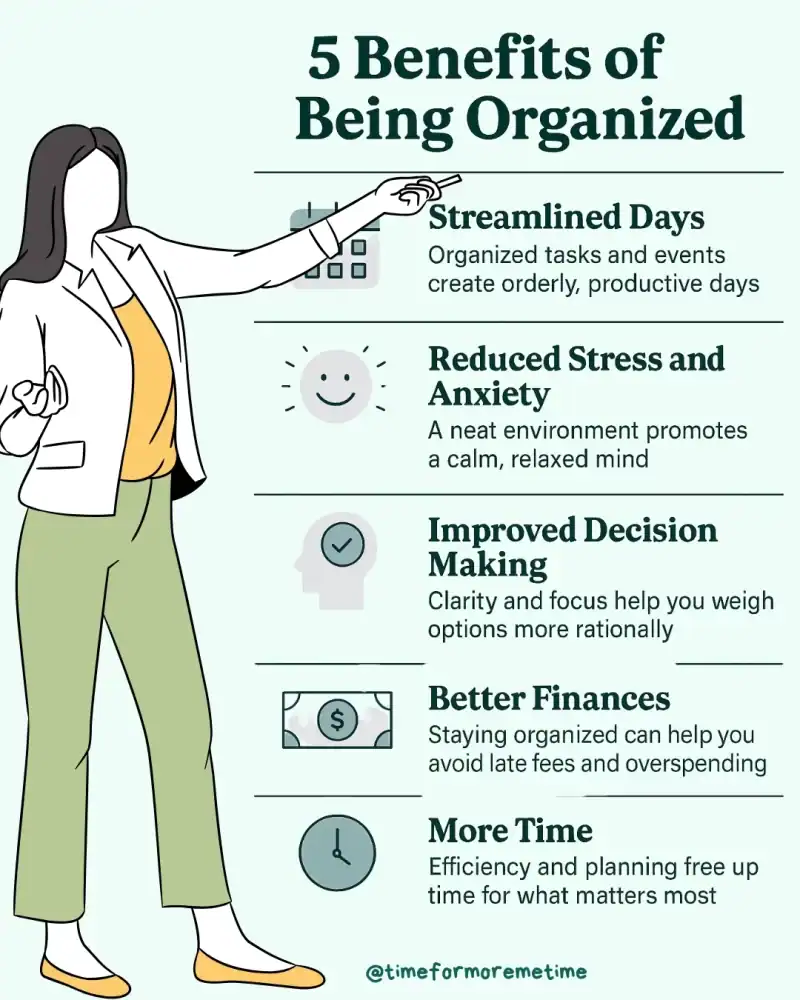
1. Streamlined Days

The benefits of being organized are numerous. Without a plan, several unfinished tasks can compete for your attention, leaving you unsure where to begin. That uncertainty may feel like boredom, but it can quickly turn into procrastination.
A 2024 study shows how structure may help. Researchers compared 109 students who completed an eight-week course with 27 students on a waiting list. During the course, the participants tracked their time, set goals, and practiced organizing their work. Their average time-management score rose from 3.19 to 3.45, while their procrastination score fell from 3.30 to 2.91.
I experienced a similar need for structure when I started my second job and realized I had to improve my daily organization. Balancing two jobs with my passion for MMA, competitions, and Tough Mudder events required a solid plan. Without a clear schedule, I would quickly fall out of sync.
2. Reduced Stress And Anxiety

Visual clutter can add to a feeling of mental overload, while cleaning may help you feel calmer.
A 2023 study involving 3,066 people from the US, UK, and Canada found that cleaning activities helped reduce lingering anxiety after stressful experiences. Participants who physically cleaned also showed a healthier cardiovascular response during a stressful task. The study did not test whether every cluttered room causes stress. Still, it suggests that clearing and cleaning your surroundings may help your mind recover when you feel overwhelmed.
Unfortunately, dealing with clutter can be challenging. I’ll admit, I was a bit spoiled by my mom when I lived with my parents. Despite her busy work schedule, she always made sure our home—and even my room—was neat and tidy.
However, everything changed when I started living on my own. I’m not a slob, but working in a hospital can be exhausting, especially with long hours. There simply isn’t enough time to clean!
In my case, since I’m often exhausted when I get home, I usually organize my things after I wake up. I dedicate at least 15 minutes to tidying up. No clutter, no unnecessary stress!
Thankfully, my home isn’t too messy since I’m only there to sleep and unwind after work.
3. Improved Decision Making

A crowded workspace can make it harder for your brain to identify what deserves attention. In a 2025 study, researchers ran two experiments with 20 participants in each group. People took longer to find important items and looked around more often as the amount of visual clutter increased. In simple terms, the busier the scene became, the more effort participants needed to locate what they were searching for.
In my experience, after becoming more organized, I find that clutter annoys and irritates me. I struggle to keep my mind focused when I see things out of place. It may be a habit I’ve developed, but it certainly makes it harder for me to think clearly and make decisions.
As I mentioned earlier, visual clutter leads to mental clutter. It’s essential to keep your mind free of distractions because doing so allows you to think with greater clarity and focus.
With this clarity and focus, you can evaluate your options more rationally and objectively, which helps you avoid impulsive decisions. In essence, maintaining an organized environment and a clear mind can significantly enhance your decision-making abilities.
4. Better Finances

Financial organization can help you avoid charges that quietly reduce your income. Payment reminders, automatic payments, and regular account checks make it easier to stay ahead of due dates. A missed credit card payment can cost up to $32, while another late payment within the next six billing cycles can cost up to $43. The fee cannot exceed the minimum payment you missed. Two late payments could therefore take as much as $75 from money you could have used for savings, debt, or investments.
Keeping your bills organized and paying them on time is essential. Additionally, creating a shopping list before heading out can help you avoid frivolous and impulsive purchases, keeping you on track with your budget. This practice also allows you to monitor your expenses more effectively, leading to better financial health overall.
5. More Time
Organization helps you move through your responsibilities with fewer interruptions. When you assign each task a clear place in your schedule, you spend less time deciding what to do next and switching between unfinished activities.
A 2023 field experiment involving 247 participants shows why protecting those work periods can help. Among them, 124 turned off communication notifications for one day. Receiving fewer alerts was linked with better reported performance and less strain because participants faced fewer interruptions. The results suggest that grouping tasks into focused blocks can make your day easier to manage, although personal habits may affect how well this approach works.
Instead of bouncing between emails, errands, and larger projects, you can finish one planned block before starting another. This gives each task your full attention and creates a clearer path through the day.
Being organized also helps you manage unexpected events and tasks that may come your way. Did your boss assign you additional work? Did friends suddenly invite you out for drinks? No problem! If your life is organized, you can easily fit in the extra workload and politely decline the invitation, knowing you’re already busy. Alternatively, you can let your friends know when you’ll be available since you have a clear understanding of your schedule.
Ultimately, this efficiency from being organized can save you time, prepare you for the unexpected, and help you run your life, both personal and professional, more smoothly!
Conclusion
And that’s about it! Being organized is an essential trait that can help you in every aspect of your life. Think of it like driving: when you have your hands firmly on the steering wheel and a clear destination in mind, you’re much more likely to reach your goal smoothly and efficiently.
Just as a driver needs to navigate the road ahead, being organized allows you to navigate your daily tasks and responsibilities with confidence. It helps you prioritize what’s important, manage your time effectively, and reduce stress. When you’re organized, you can focus on the journey rather than getting sidetracked by distractions or feeling overwhelmed.
Did that make me sound cool and wise? Hopefully! Anyway, if you’d like more content like this, be sure to subscribe to my mailing list, follow my social media accounts, and stay tuned to my YouTube channel. Thanks!
Sources
- Photos: Unsplash: Andrei Slobtsov
- Frontiers. (2024). Explaining the changes in procrastination in an ACT-based course: Psychological flexibility and time and effort management as mediators. https://www.frontiersin.org/journals/psychology/articles/10.3389/fpsyg.2024.1331205/full
- Social Psychological and Personality Science. (2023). Actual cleaning and simulated cleaning attenuate psychological and physiological effects of stressful events. https://pmc.ncbi.nlm.nih.gov/articles/PMC11925691/
- Springer Nature. (2025). The effect of background clutter on visual search in video conferencing. https://link.springer.com/article/10.1186/s41235-025-00643-4
- Electronic Code of Federal Regulations. (2026). 12 CFR § 1026.52: Limitations on fees. https://www.ecfr.gov/current/title-12/chapter-X/part-1026/subpart-G/section-1026.52
- Consumer Financial Protection Bureau. (2024). Why did my credit card issuer increase my late payment fee? https://www.consumerfinance.gov/ask-cfpb/why-did-my-credit-card-issuer-increase-my-late-payment-fee-en-56/
- Journal of Occupational Health. (2023). Effects of task interruptions caused by notifications from communication applications on strain and performance. https://academic.oup.com/joh/article/65/1/e12408/7479297