

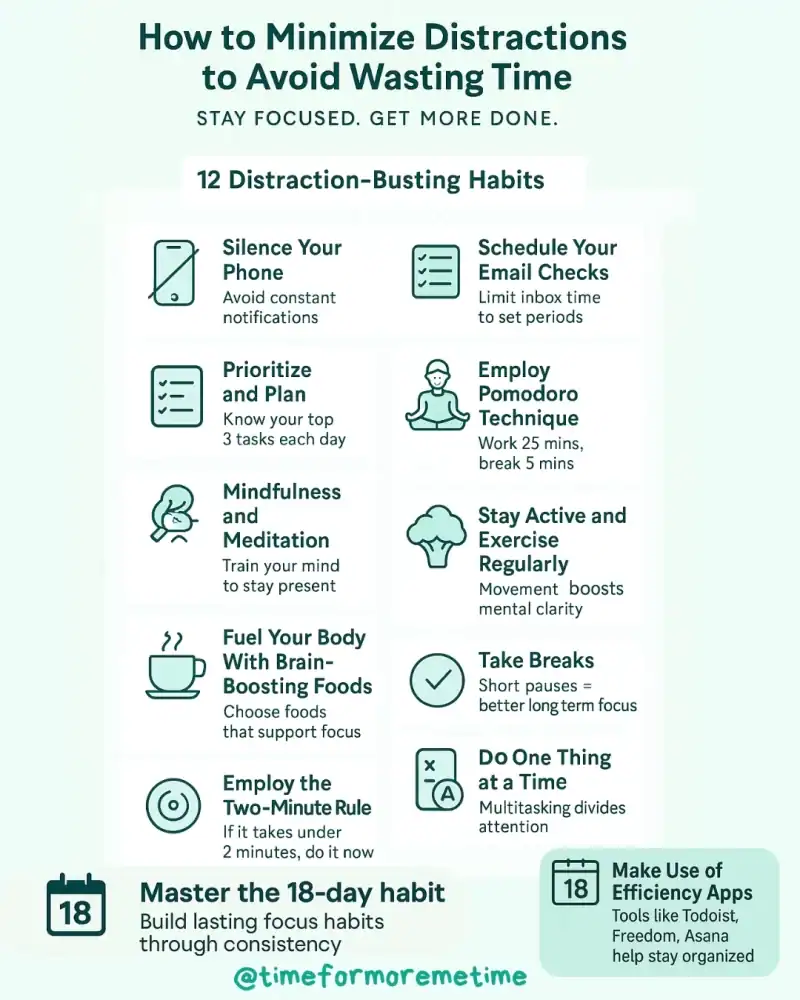
While occasional distractions are normal, constant interruptions can disrupt your life. It’s essential to learn how to minimize distractions, whether you’re a student or an entrepreneur. So, how can you minimize distractions? Here are some actionable tips to help minimize distractions. Let’s get started!
1. Silence Your Phone
People’s attention on digital screens has declined sharply. UC Irvine research found that the average time spent focused on one screen fell from 2.5 minutes in 2004 to just 47 seconds, a 69% decrease. The report behind this may be disputed, but you can try to observe it yourself. And unfortunately, these digital distractions come from essential devices and technology that we rely on.
So, what’s the solution? Use the distraction-minimizing features on your devices. For your phone, consider setting it to silent or enabling Do Not Disturb (DND) mode. If you want to avoid distractions entirely, you can also switch to airplane mode.
2. Schedule Your Email Checks
Email is a classic attention trap because it’s both urgent-feeling and unpredictable. Even if you tell yourself you’ll just skim the messages, email trains you to switch contexts repeatedly—responding, deciding, searching, and bouncing back and forth between messages. Over time, it turns into a time sink.
Instead of checking continuously, treat email like a task with boundaries:
- Choose fixed email windows (e.g., 1 hour after you start work and 30–60 minutes before you end your day).
If your schedule allows, add a midday check for short replies.
During your email windows, triage quickly, draft responses in one pass where possible, and send or schedule before you leave the window.
A useful rule: outside the email window, you don’t open your inbox. If something feels urgent, capture it in a note and handle it during the next check (or route true emergencies through another channel, if you have one).
3. Prioritize And Plan
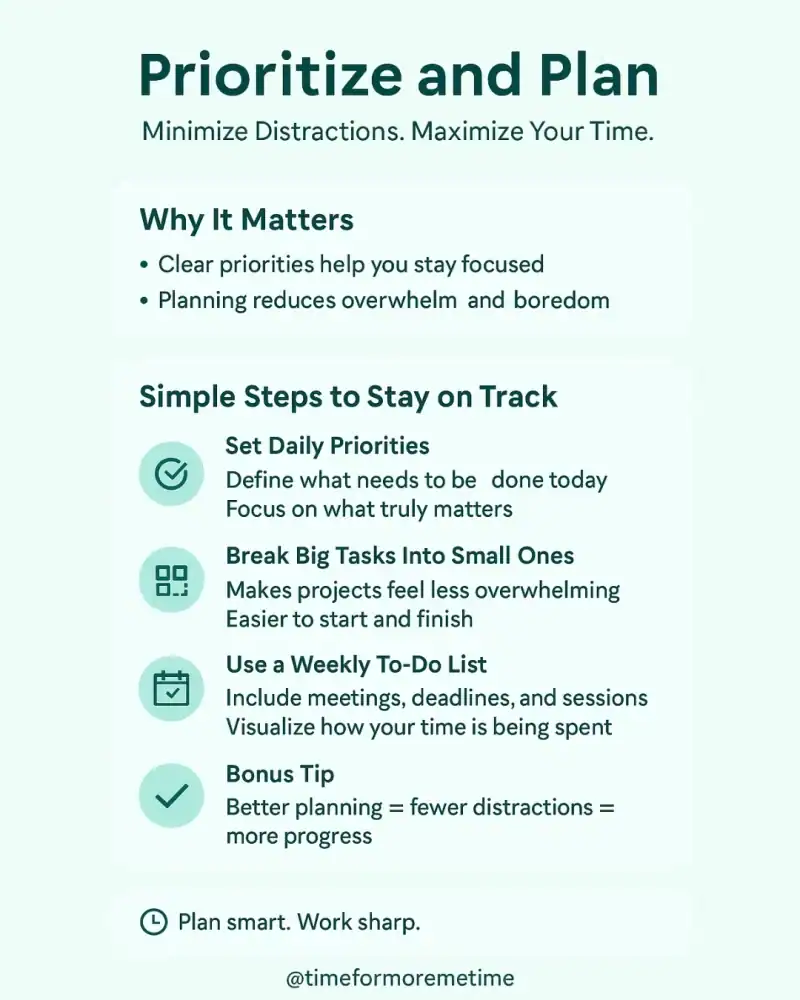
To effectively manage your time, start by clearly defining your priorities for the day. Break larger tasks into smaller, more manageable ones to avoid feeling intimidated or overwhelmed. With better time management, you can go through your day without getting bored or distracted.
For instance, create a weekly to-do list that includes all your work-related activities, such as attending meetings, completing projects, or participating in training sessions. By listing these tasks, you’ll gain a clear understanding of how you’re spending your time.
4. Employ Pomodoro Technique
The Pomodoro technique is an effective time management method that helps you maintain focus while working on smaller goals. This can effectively pull you away from distractions.
To use this technique, set a 25-minute timer and concentrate on a single task without distractions. After 25 minutes, take a five-minute break. Repeat this cycle four times, and then take a longer break of 15 to 20 minutes.
5. Mindfulness And Meditation
Mindfulness helps you focus on the present instead of following every distraction. A 2023 study of 431 web editors linked higher mindfulness with better work performance. Another workplace study found that a few minutes of focused meditation each day improved emotional well-being and helped prevent concentration problems.
Try a short breathing exercise before demanding work or when stress begins to interrupt your focus.
6. Stay Active And Exercise Regularly
Prioritize 30 minutes of moderate exercise on five days each week. A 2025 review found that 16 to 35 minutes of moderate aerobic exercise can improve attention control, working memory, and mental flexibility. Even a brisk walk may help you return to work more focused and less distracted.
7. Fuel Your Body With Brain-Boosting Foods
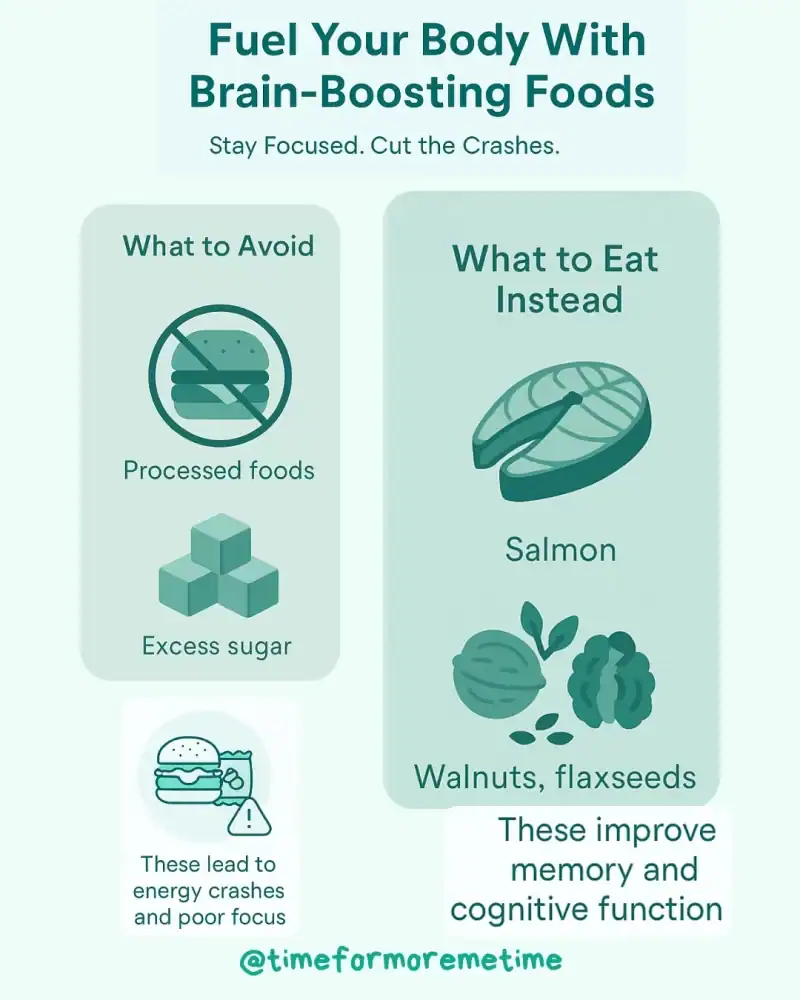
Limit ultra-processed foods when you need steady concentration. A 2026 Australian study of more than 2,100 adults linked every 10% increase in ultra-processed food intake with lower attention scores. Instead, choose minimally processed meals and include omega-3 sources such as salmon, walnuts, and flaxseeds.
A 2025 review of 58 randomized trials found that omega-3s may modestly support memory and other cognitive skills, although the overall effect on attention remained uncertain.
8. Take Breaks
Strategic, purposeful breaks can enhance focus and productivity. While distractions can prompt necessary pauses, ensure your breaks are purposeful. Engage in activities like a 15-20 minute nap, a walk, or deep breathing to rest your mind and recharge. Avoid unproductive distractions like scrolling social media during these breaks.
9. Employ The Two-Minute Rule
The two-minute rule is an effective way to minimize distractions. If a task takes less than two minutes, complete it immediately—whether it’s responding to an email, filing a document, or sending a quick text. This prevents small tasks from interrupting larger projects.
10. Do One Thing At A Time
Multitasking often becomes rapid task switching, which can slow your work and increase mistakes. A 2022 study found that even simple competing tasks could delay a second response by half a second or more. Text messages, emails, and unexpected meetings can make those delays add up.
Instead, silence notifications and focus on one important task before moving to the next. This approach fosters a productive flow state, allowing you to work deeply and efficiently without losing focus.
11. Make Use Of Efficiency Apps
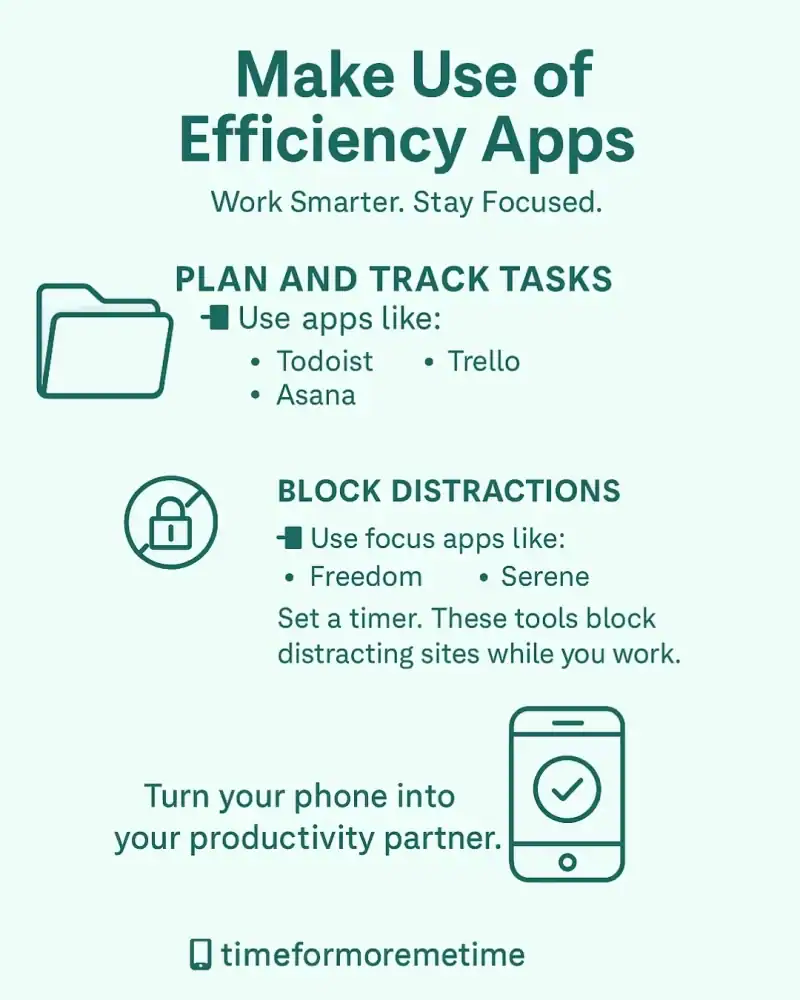
Utilize productivity apps like Todoist, Trello, and Asana to plan your day, track progress, and meet deadlines, helping to centralize your tasks and reduce mental juggling. Additionally, apps like Freedom and Serene can block distracting websites, allowing you to focus better. Simply set a timer, and these apps will restrict access to distractions, increasing your chances of completing important tasks.
12. Mastering The 18-Day Habit
To eliminate distractions and develop productive habits, commit to a consistent schedule for at least 18 days. Follow a consistent schedule to turn productive actions into habits. A 2024 review found that habits typically began forming within 59 to 66 days, though results ranged from 4 to 335 days.
Regardless of the specific timeframe, it’s essential to remain disciplined, even when you feel tempted to procrastinate, as putting off work will not lead to success. Consistency in your tasks and schedule is crucial for training your mind and body to complete tasks on time.
Conclusion
Minimizing distractions is crucial for productivity. Use the tips I provided here to save time and complete tasks effectively. Experiment with different methods until you find what works best for you.
If you find my content helpful, be sure to subscribe to my newsletter. You can also follow my social media accounts and watch my videos on my YouTube channel.
Sources
- Photos: Unsplash: Marco Palumbo
- UC Irvine. (2023). UCI Podcast: If you can’t pay attention, you’re not alone. https://news.uci.edu/2023/05/05/uci-podcast-if-you-cant-pay-attention-youre-not-alone/
- Frontiers in Psychology. (2023). A study on the relationship between mindfulness and work performance of web editors. https://www.frontiersin.org/journals/psychology/articles/10.3389/fpsyg.2022.1068735/full
- PLOS ONE. (2023). Doing what matters in times of stress: No-nonsense meditation and occupational well-being in COVID-19. https://journals.plos.org/plosone/article?id=10.1371/journal.pone.0292406
- PubMed Central. (2025). The acute effects of moderate-intensity aerobic exercise on core executive functions. https://pmc.ncbi.nlm.nih.gov/articles/PMC11856442/
- Monash University. (2026). Ultra-processed foods damage your focus even if you eat healthy. https://www.monash.edu/medicine/news/latest/2026-articles/ultra-processed-foods-damage-your-focus-even-if-you-eat-healthy
- Springer Nature. (2025). A systematic review and dose response meta analysis of Omega 3 supplementation on cognitive function. https://www.nature.com/articles/s41598-025-16129-8
- Frontiers. (2022). Inter-individual differences in executive functions predict multitasking performance: Implications for the central attentional bottleneck. https://www.frontiersin.org/journals/psychology/articles/10.3389/fpsyg.2022.778966/full