


Life feels heavier when everything demands your attention—work deadlines, bills, family needs, and a phone that never stops buzzing. Did you know that cluttered environments and scattered priorities can raise stress hormones and reduce productivity, leaving you drained before the day even starts?
I know how it feels to wake up already tired, wondering where your time and energy went—but the good news is, it doesn’t have to stay that way.
Before, I’ve struggled to balance work, family, and finances while chasing too many goals at once. When I started this blog while working two hospital jobs in San Francisco, I realized that small inefficiencies—like cluttered bills, messy routines, and scattered goals—were stealing my peace of mind. After years of trial, reflection, and habit building, I discovered that decluttering your life isn’t just about cleaning your space.
In this guide, you’ll learn practical ways that I learned over the years to declutter your life. Let’s get started.
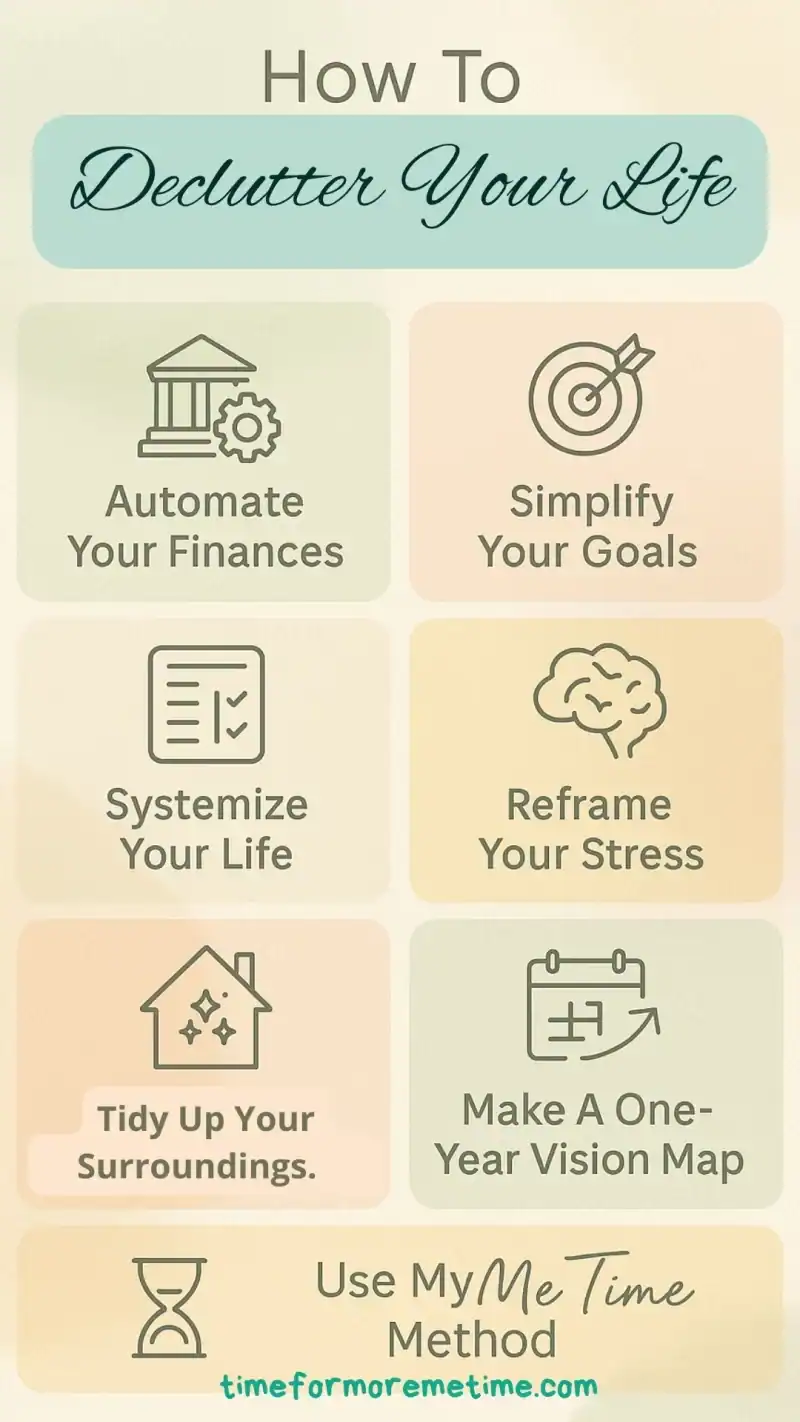
1. Automate Your Finances
Financial clutter, such as overdue bills, unclear balances, and scattered accounts, can occupy valuable mental space. This connection is reflected in a 2025 survey of 4,626 US adults. I also experienced that, but when I first automated my bill payments and savings, I instantly freed up hours of worry each month—and my stress level dropped just as fast.
Many financial experts agree that automation reduces stress and helps people stay consistent with savings and payments, as shown in Vanguard’s 2025 analysis of nearly 5 million retirement-plan participants. Those who automatically enrolled had a 94% participation rate, compared with 64% under voluntary enrollment.
Automatic enrollment was therefore linked to a participation rate about 47% higher. Decluttering your finances isn’t about having more money—it’s about having fewer moving parts that demand your attention.
What if every dollar you earned had a clear purpose before it even hit your account? Try the three-bucket rule: one account for essentials, one for savings, and one for fun. With it, you can track spending at a glance and put an end to money chaos.
2. Simplify Your Goals
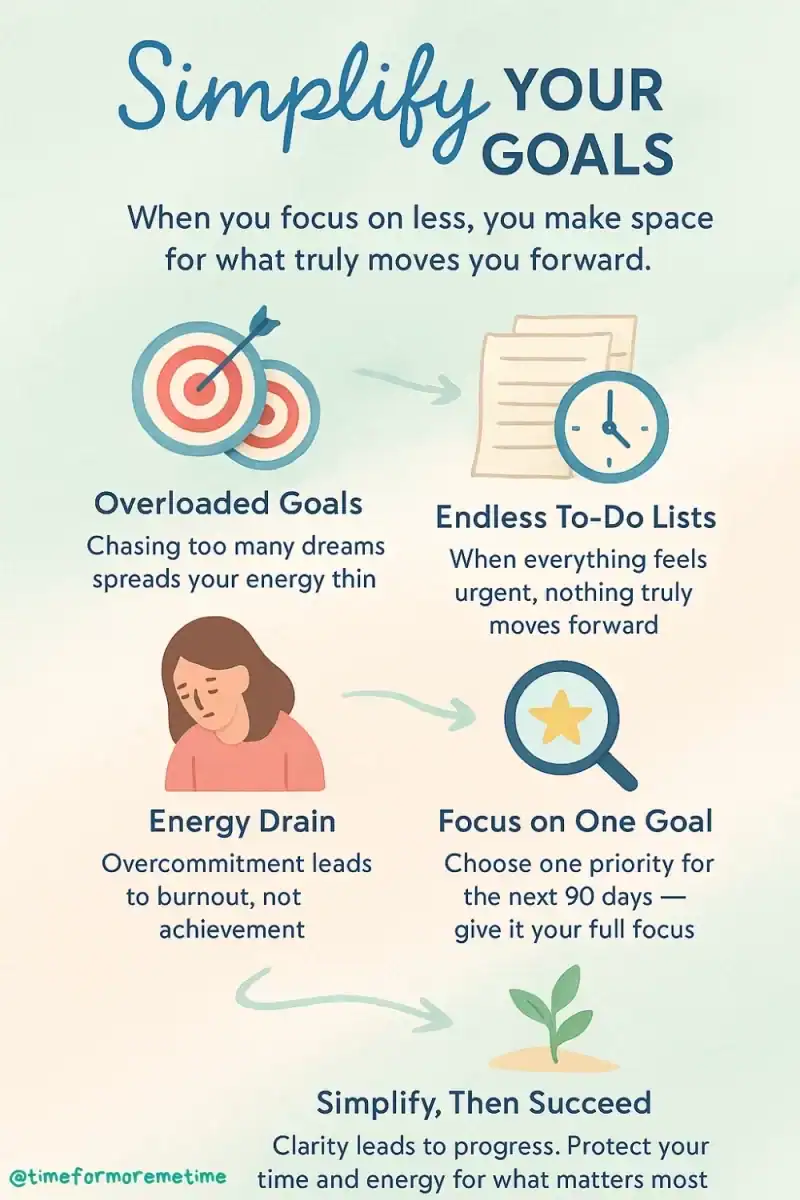
Decluttering your life also means decluttering your goals. When you try to pursue too many dreams at once, you scatter your time and energy, leaving little progress in anything. Years before, I was juggling fitness, blogging, and multiple side hustles. And then I realized I was achieving more exhaustion than success.
Behavioral research shows that people are two to three times more likely to build lasting habits when they focus on one specific goal at a time. Simplifying your goals doesn’t solely mean giving up ambition. It also means protecting your energy for what truly matters. If your to-do list feels endless, it’s not because you’re lazy. It’s simply because your goals are overcrowded.
Imagine what could happen if you gave your full focus to one goal for the next 90 days. Write down your top five priorities and circle the one that would make the biggest impact. Focus and start there first.
3. Systemize Your Life
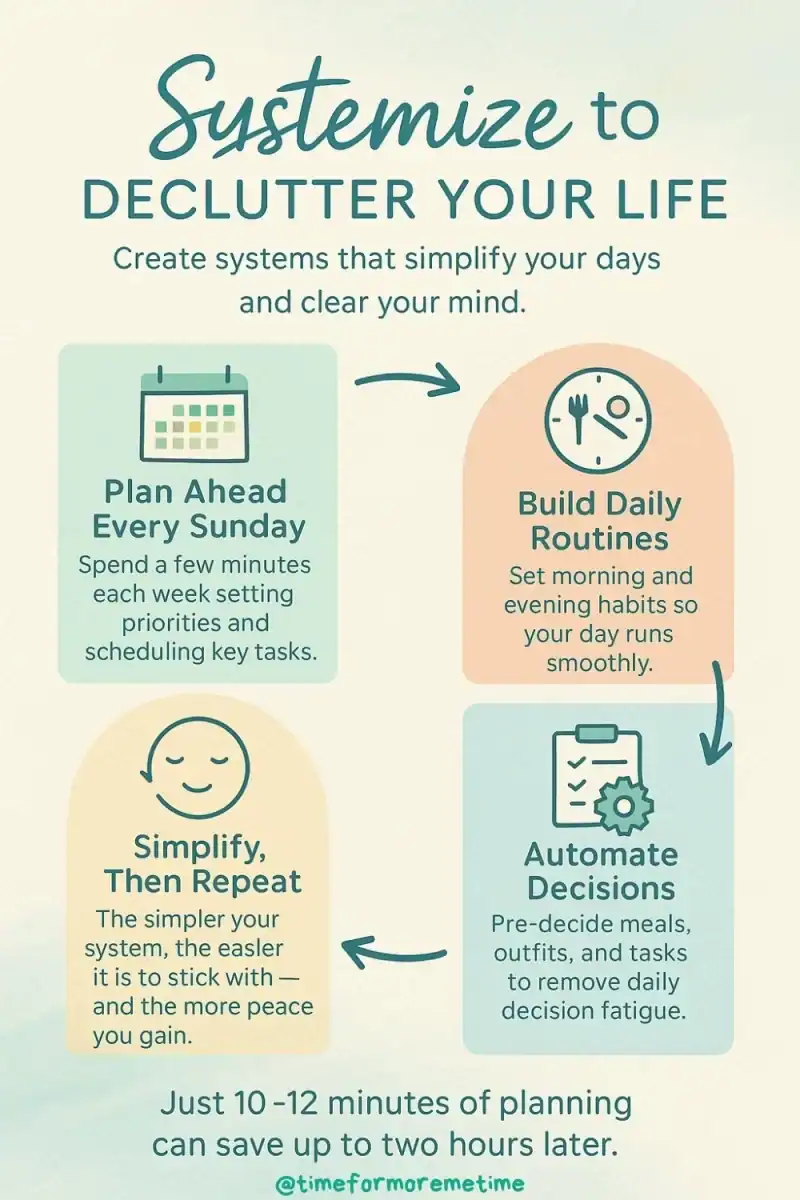
Decluttering isn’t just about removing things, but it’s also about creating systems that keep life organized automatically. Systemizing your life means setting up routines and structures that make decisions easier, so you don’t waste time thinking about what to do next.
When I was working long shifts in radiation oncology, I often felt tired but unaccomplished. And I found out that my days lack a clear system. So, I started planning my week every Sunday, and this turned my chaotic mornings into calm, predictable days.
A routine can create more freedom by deciding in advance when important tasks will happen. That benefit is supported by a 2021 meta-analysis covering 158 studies and 53,957 participants, which included planning, scheduling, and following a daily routine as time-management behaviors.
Stronger time management shared about 6% of the differences in workplace performance and about 13% of the differences in psychological distress. For example, choosing tomorrow’s top three tasks tonight can remove three decisions from an already busy morning.
Fun fact: Time-management research suggests that spending just 10–12 minutes planning your day can save up to two hours later.
4. Tidy Up Your Surroundings
Decluttering your space is the most visible and instantly rewarding step toward decluttering your life. Your physical environment mirrors your mental state, so when your space is chaotic, your thoughts often follow. I once started by cleaning a single kitchen drawer after a stressful week; by Sunday, I’d cleared half my apartment—and felt lighter, calmer, and more focused.
Research from UCLA found that people living in cluttered homes had higher cortisol levels and greater mood swings compared to those in organized spaces. A cluttered environment constantly reminds your brain of unfinished tasks, which silently drains mental energy. If you’ve ever felt tense walking into your own home, it’s not just the mess—it’s the noise your environment is sending your mind.
What if you could create peace just by handling each item once? Use the one-touch rule: when you pick something up, put it where it belongs instead of setting it aside. As your surroundings clear, your focus sharpens—reminding you that decluttering your environment is really decluttering your mind.
5. Reframe Your Stress

A person’s perspective can often become cluttered, particularly in how they perceive stress. Instead of seeing stress as chaotic, try to view it as valuable feedback that indicates areas for growth and improvement. For instance, when I trained for an MMA fight at 46, the intense pressure highlighted my limits and habits, ultimately strengthening my resilience.
Stanford’s Rethink Stress studies found that people who view stress as an opportunity for growth experience better emotional health and performance. You can’t eliminate stress, but you can control its meaning—turning it from a mental burden into a source of motivation. If stress feels like clutter in your mind, shifting your mindset can help you see it as data, not danger.
Remember that every stressful moment is simply a mirror reflecting where you need to focus next. The next time you feel overwhelmed, pause and ask, “What is this teaching me?” instead of “Why me?” When you declutter your mindset, even pressure becomes purposeful—and peace becomes something you can practice, not chase.
6. Make A One-Year Vision Map
A one-year vision map gives your goals a timeline, direction, and daily anchor—without overcomplicating your life plan. Instead of a ten-year roadmap, focus on what you can realistically transform in the next twelve months. I used this method the year I started my blog, and it worked better than any five-year plan I’d ever made.
Research by Dominican University found that people who write down clear goals have the potential to earn 10 times more than others who don’t after 20 years. Imagine waking up every morning knowing exactly what you’re working toward—and why. Grab a notebook and create three columns labeled “What,” “Why,” and “Next Step.” Fill them in for your top three goals. This quick exercise aligns your time, motivation, and daily actions without overwhelming your schedule.
7. Use My Me Time Method
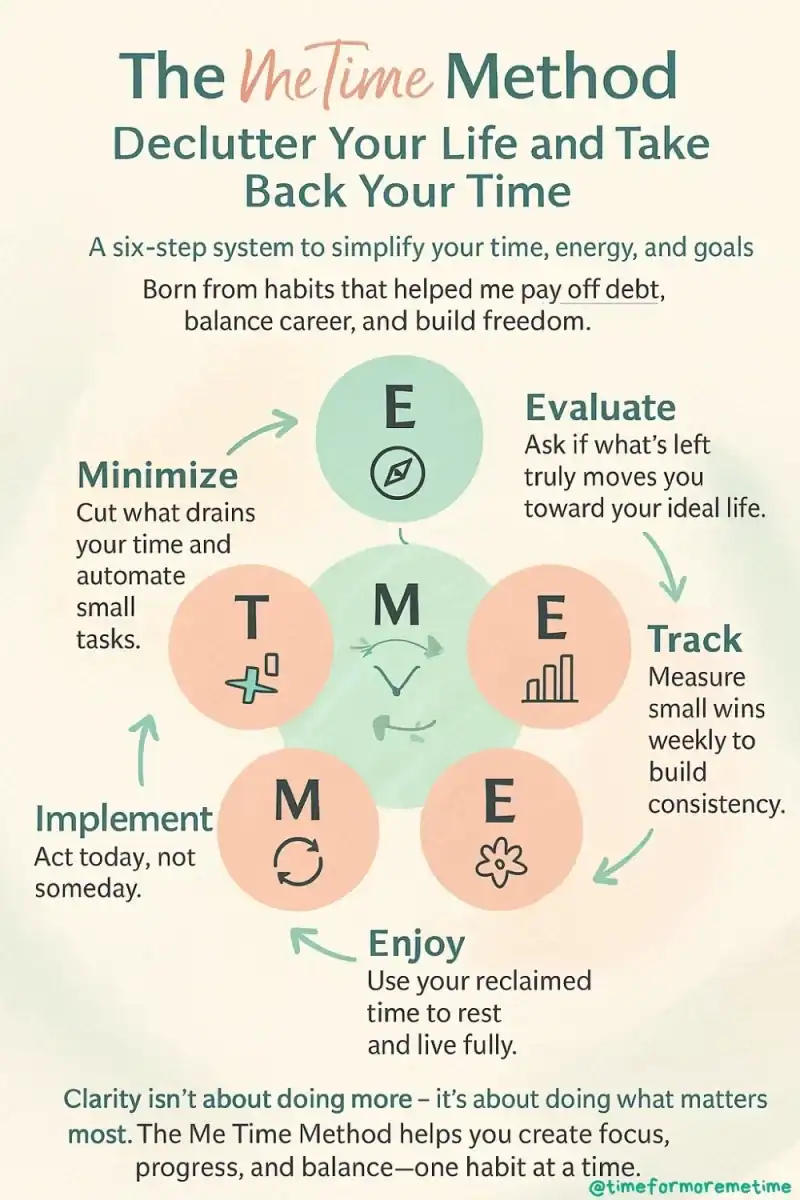
Over the years, I’ve developed a personal system called The Me Time Method, a simple yet powerful framework for decluttering your time, mind, and goals. It’s a six-step method—Minimize, Evaluate, Track, Implement, Maintain, and Enjoy—that helps you simplify life without sacrificing ambition. This approach grew from the same habits that helped me pay off $90,000 in debt, balance a full-time oncology career, and still find time to build this blog.
Most of my personal acquaintances I privately coached or spoke with struggle not because they lack motivation, but because their goals compete for time and attention. The Me Time Method turns that chaos into clarity by focusing on what gives back energy instead of what drains it. I know how easy it is to fall into the “busy but unfulfilled trap”—it’s why this method emphasizes small, sustainable actions over massive, short-lived efforts.
What if you could run your days instead of letting your days run you? Start with one letter at a time:
- Minimize: Cut what drains your time and automate small tasks.
- Evaluate: Ask if what’s left moves you toward your ideal life.
- Track: Measure your wins weekly to build consistency.
- Implement: Act today, not someday.
- Maintain: Review and reset monthly.
- Enjoy: Use the time you’ve gained to rest and live fully.
This method is simple and clear-cut. Easy to remember, too! It can help you have a lifestyle that keeps your focus clear and your life balanced. Once you apply it, you’ll find yourself with more energy, more progress, and most importantly, more time for you.
Conclusion
Simplicity is not about having less; it’s about making room for what truly matters. By removing excess and clutter—whether mental, financial, or emotional—you reveal what fulfills you: time, peace, and purpose. From Buffalo to San Francisco, I learned that simplicity gave me control over my story.
Every lesson—wise earning, intentional saving, valuing your time, and nurturing your mind—leads to the same truth: freedom. Financial independence, mental clarity, and emotional peace are outcomes of living simply and deliberately.
That’s all for now! If you’re interested in exploring other life winning guides and achieving financial freedom, be sure to check out my website, social media, and YouTube channel. Thank you for your time!
Sources
- Photos: Unsplash: Brett Jordan
- Northwestern Mutual. (2025). Nearly 70% of Americans say financial uncertainty has made them feel depressed and anxious, according to Northwestern Mutual 2025 Planning & Progress Study. https://news.northwesternmutual.com/2025-06-03-Nearly-70-of-Americans-Say-Financial-Uncertainty-Has-Made-Them-Feel-Depressed-and-Anxious,-According-to-Northwestern-Mutual-2025-Planning-Progress-Study
- Vanguard. (2025). A sneak peek at How America Saves 2025. https://corporate.vanguard.com/content/corporatesite/us/en/corp/articles/sneak-peek-how-america-saves-2025.html
- James Clear. (2016). The scientific argument for mastering one thing at a time. https://jamesclear.com/master-one-thing
- ABC News. (2019). How clutter affects your health. https://abcnews.com/Health/clutter-affects-health/story?id=60367240
- Stanford SPARQ. (n.d.). To work better, rethink stress. https://sparq.stanford.edu/solutions/work-better-rethink-stress
- Dominican University of California. (2007). Goals research summary. https://www.dominican.edu/sites/default/files/2020-02/gailmatthews-harvard-goals-researchsummary.pdf
- PLOS ONE. (2021). Does time management work? A meta-analysis. https://journals.plos.org/plosone/article?id=10.1371/journal.pone.0245066
- CornerStone Dynamics. (n.d.). Time management stats that may surprise you. https://www.cornerstonedynamics.com/time-management-stats-that-may-surprise-you/