


Feeling overwhelmed by endless to-do lists and constant distractions? You’re not alone. In this post, we’ll delve into the focus funnel—a time-management method designed to help you eliminate, automate, or delegate tasks, allowing you to focus on what truly matters. Let’s get started!
What Is The Focus Funnel
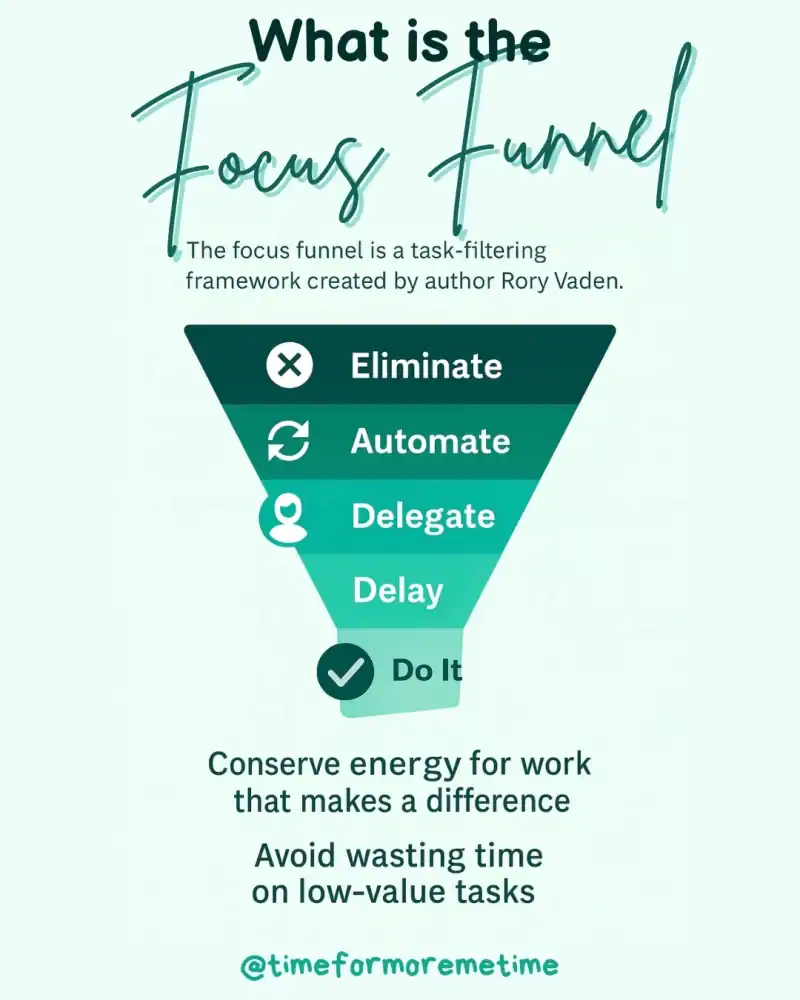
The focus funnel is a task-filtering framework developed by author Rory Vaden. It guides you through a sequence of questions to determine the best action for each task: eliminate, automate, delegate, delay, or do it.
The method encourages critical thinking about how you spend your time. Instead of defaulting to doing everything, you evaluate whether a task adds value or can be handled in a more efficient way. This approach can recover valuable time, since knowledge workers spend 60% of their day on tasks that take them away from skilled work.
By passing each task through the funnel, you conserve your energy for the work that truly makes a difference. The core idea is to stop wasting time on low-value tasks and start spending more time on meaningful priorities.
Why Use The Focus Funnel
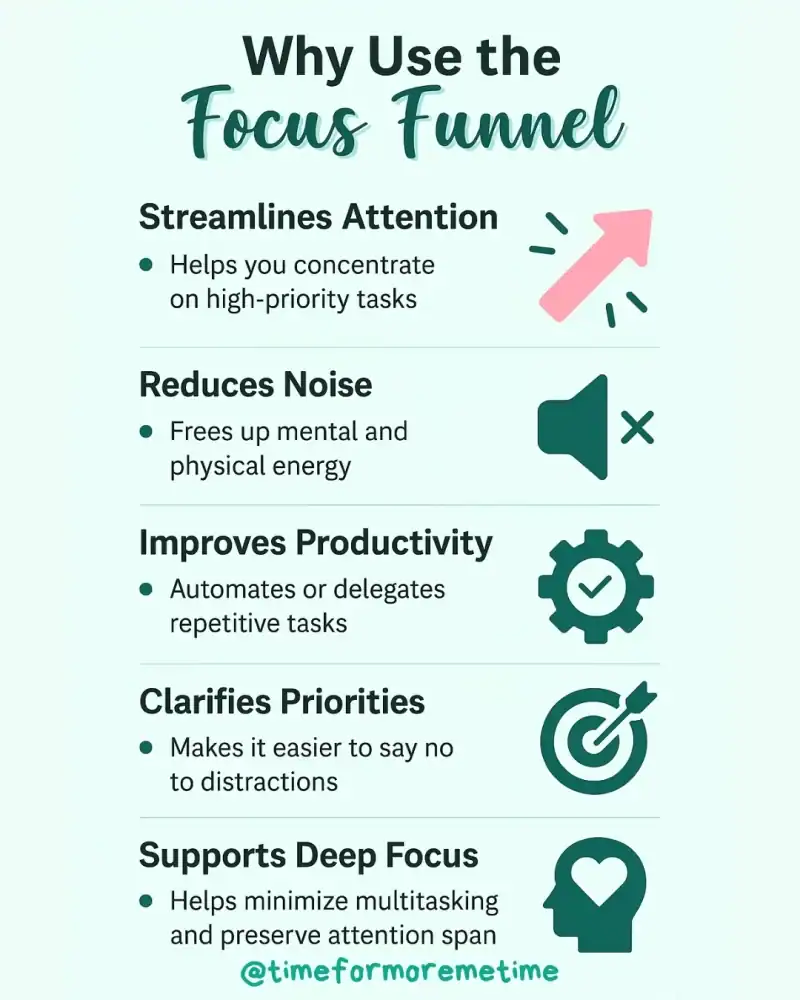
Using the Focus Funnel can bring order and clarity to a hectic schedule. In a 2023 experiment with 208 employees, workers spent about eight minutes ranking three weekly goals, planning the steps, and preparing for obstacles. This led to fewer unfinished tasks and better mental flexibility.
The Focus Funnel uses a similar pause-and-review process by asking you to eliminate, automate, delegate, or delay lower-value tasks before focusing on your main priority. As you move through the funnel, your priorities become clearer, making it easier to say no to what doesn’t align with your goals. This, in turn, supports a deeper focus, helping you minimize multitasking and preserve your attention span.
Over time, applying the focus funnel may even help prevent burnout by ensuring your energy is spent where it truly counts. In short, this method promotes clarity and control, giving your daily workflow a structure that supports long-term goals. Ultimately, it can lead to time savings.
How To Start Using The Focus Funnel
You can apply the focus funnel whenever a new task lands on your plate or while reviewing your to-do list. Whether you’re organizing a packed week or navigating daily priorities, this method helps you filter what truly deserves your attention. Here’s how to get started:
- Eliminate: Ask, “Does this need to be done at all?” If not, let it go. Eliminating unnecessary tasks instantly frees up time.
- Automate: If the task recurs frequently, consider exploring ways to automate it using tools such as reminders, templates, or specialized software.
- Delegate: Can someone else handle it? Delegation enables you to focus on tasks that align with your skills and responsibilities.
- Procrastinate on Purpose: If the task isn’t urgent, schedule it for later. Intentional delay helps protect your current focus.
- Concentrate: Only now should you do the task. Give it your full attention, knowing it truly deserves your time.
This process encourages deliberate decision-making before investing your time and resources. By using the funnel regularly, you reinforce habits that support productivity and reduce overwhelm.
What Are The Drawbacks Of The Focus Funnel
Even the most effective productivity systems have their downsides, and the focus funnel is no exception. While it helps streamline decision-making, some challenges may arise depending on your work style and responsibilities. Here’s what to watch out for:
- Learning Curve: It may feel awkward at first to question every task, especially if you’re used to reacting on the fly. Adopting this approach takes practice and patience, as it requires a mindset shift from doing to evaluating first.
- Not Always Applicable: Some roles or responsibilities require fixed tasks that can’t be delegated or automated. In structured environments, the flexibility the focus funnel offers may be limited.
- Upfront Time Cost: Setting up systems to automate or delegate tasks takes initial effort. While the long-term savings are worth it, the setup phase can feel time-consuming and tedious.
- Overthinking Risk: Overanalyzing simple tasks can slow you down instead of improving the result. In one study, 74% of students completed an essay when given six topic choices, compared with 60% when given 30. The lower completion rate suggests that too many options can delay decisions and make people less likely to act. Use the funnel for complex tasks, but move quickly when the choice is simple and low-risk.
- Misjudged Elimination: You might cut tasks that seem unimportant but have hidden value. Without context or long-term thinking, you risk discarding functions that contribute to your broader goals.
The focus funnel is most effective when used with intention and balance. It’s not about perfection—it’s about gradually improving how you manage your time and attention.
Conclusion
The focus funnel is a simple but powerful way to reclaim your time. By eliminating the unimportant and focusing only on what truly matters, you free yourself from distraction and create space for meaningful progress.
To get more tips on productivity, mindset, and saving time, subscribe to our blog, follow us on social media, and check out our YouTube channel for helpful content.
Sources
- Photos: Unsplash: Magnet.me
- Asana. (2026). How work about work gets in the way of real work. https://asana.com/resources/why-work-about-work-is-bad
- PubMed Central. (2023). A field experiment on the effects of weekly planning behaviour on work engagement, unfinished tasks, rumination, and cognitive flexibility. https://pmc.ncbi.nlm.nih.gov/articles/PMC10952538/
- Frontiers. (2024). On the advantages and disadvantages of choice: Future research directions in choice overload and its moderators. https://www.frontiersin.org/journals/psychology/articles/10.3389/fpsyg.2024.1290359/full