


It’s almost bedtime, and you’re lying there, asking yourself, “Where did the day go?” Sound familiar? We’ve all been there. When I got my second job, this became a nightly routine. After just a week, I’d find myself staring at the ceiling, wondering how the day slipped away.
You know that feeling—as you settle into bed, a pang of guilt creeps in, reminding you that you didn’t accomplish what you set out to do. It’s frustrating, but it’s also a clear sign something is eating away at your productivity: time wasters.
And here’s the funny part—in my case, I was spending most of my time at work. So why did I still feel guilty?
The answer hit me after some thought. Sure, I was working hard, but what about those moments I got sidetracked? Maybe it was endless scrolling through social media—those adorable animal videos are hard to resist—or falling into a never-ending internet rabbit hole.
It turns out, those seemingly small distractions were stealing hours from my day without me even realizing it. And if you’re feeling the same way, chances are, it’s happening to you, too.
Whether you’re juggling work deadlines, family responsibilities, or personal goals, identifying what’s wasting your time is the first step toward reclaiming it. Awareness is key to breaking free from unproductive habits and making the most of your day.
But here’s the thing: Before you can find solutions, you have to pinpoint the real problems.
What are the top things that waste your time and hinder your productivity? By recognizing these common pitfalls, you’ll be better equipped to tackle them head-on and take back control of your time. Let’s get started!
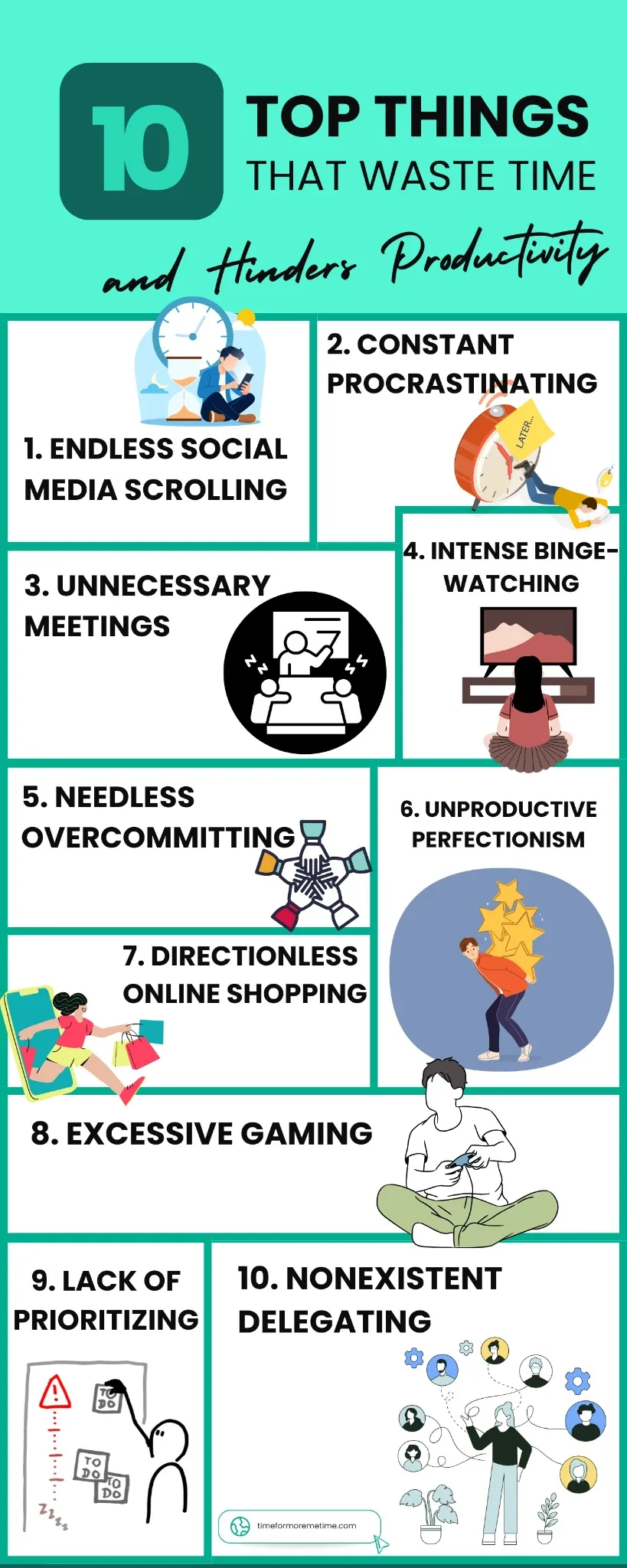
1. Endless Social Media Scrolling

We’ve all done it. Even in the middle of a task, I often find myself grabbing my phone to quickly check a notification. But that was ages ago, when I didn’t know these things that waste time. When this happens, the next thing we know, an hour is gone.
We’ve scrolled through countless memes, cute puppy videos, and targeted ads without even realizing it. This is a huge time-waster, especially when we’re trying to save time, build a side hustle, or make extra money.
Think about how much time you spend on social media daily. The average internet user spends 2 hours and 21 minutes on social media each day. Cutting that time in half would free about 70 minutes per day, or nearly 429 hours per year.
That equals almost 18 full days you could redirect toward building your online business, learning a marketable skill, exercising, or resting. Reducing social media will not automatically make you more productive, so decide in advance how you will use the time you regain.
The first step to stop wasting time on social media is to be mindful of your usage. Here are things I did when I realized my excessive social media usage:
Setting time limits on my apps.
Scheduling specific times of day to check my feeds.
Disabling notifications of social media apps so I’m not constantly being pulled back in.
Unfollowing accounts that don’t bring me joy or add value to my life.
Turning off my smartphone is one of the best remedies to ensure I don’t get sidetracked with notifications.
Doing these actions helped me practice responsible social media use. I no longer scroll mindlessly, which may even lead to negative emotions when I see the “perfect” lives of these people on social media.
2. Constant Procrastinating

Procrastination is more common than you may think. In a 2025 study of 986 college students, 518 regularly postponed academic tasks despite knowing those delays could affect their results. The same habit can slow your effort to earn extra money when you keep putting off applications, client outreach, or paid projects.
Procrastination sucks the life out of your goals. It whispers sweet lies, like, “You’ve got plenty of time,” or “Just one more episode.” You get to check useless websites just to pass the time. But don’t listen! Those are time-wasting traps, my friend.
You need to be laser-focused and let go of this time killer. Think about your goals—really think about them. You want to be financially free, right?
Then you have to fight for it. That means kicking procrastination to the curb. This is your time, and you’re not going to waste it. And here’s how you can keep procrastination away:
Start by breaking down big tasks into smaller, less scary ones. This makes it way easier to get started.
And what I don’t forget is to celebrate my small wins! Whenever I finish a small part of that big project, I pat myself on the back and indulge myself with a steak or wine. Do anything that will encourage you to keep going—if this worked for me, I know it will also work for you.
Also, try to figure out what makes you procrastinate. Are you scared of failing? Do you get distracted easily? Once you know what your triggers are, you can find ways to beat them. For example, I know I waste a lot of time on social media, so I use a website blocker. This helped me stay focused on my work.
Simple right? However, controlling procrastination requires considerable discipline. But you can do this! And if you can’t help it, try to find a good website to cure boredom fast, to lessen the amount of time you procrastinate!
3. Unnecessary Meetings

We’ve all been there, stuck in a meeting that feels like a total waste of time. Sometimes, work seems to try to solve every problem with another meeting, but meetings should be the last resort, not the first option. And let me be straight with this: meetings are just daily time-wasters.
Currently, I’m thankful that I’m free of this with my current job. And this is the same for my team managing this website. We don’t have scheduled meetings. We talk and work as we go. I don’t want to waste everyone’s time!
Meetings can take time away from both focused work and your personal life. In an Atlassian survey of 5,000 knowledge workers across four continents, 78% said their meeting schedules made it harder to finish their work. Another 51% reported working overtime at least several days a week because of meeting overload. Reducing unnecessary meetings could help you finish earlier and reclaim time for your family, personal errands, or an evening with your partner.
That’s why, before you send out another meeting invite, ask yourself whether you can handle the situation at work with a quick email or a phone call. If a message or quick call will suffice, you can save everyone time and boost productivity.
This is super important for digital nomads or online entrepreneurs because time management methods are vital when you’re building a business.
4. Intense Binge-Watching
Binge-watching can help you relax, but a long session may consume much of your free time. In a survey of nearly 500 US adults, the average binge lasted about 3.5 hours before the pandemic and nearly 4 hours during it. One four-hour session each week adds up to 208 hours a year, equal to 26 eight-hour days.
You do not need to stop watching your favorite shows. Setting an episode or time limit could leave more room to learn a skill, develop a side hustle, work on a business, or simply rest without losing the entire evening.
Beyond just the time wasted, binge-watching has other drawbacks. Eventually, you’ll run out of shows to watch. Instead of savoring the joy of one episode each week, you might find fleeting happiness in binge-watching an entire season in a single day. It’s inefficient, isn’t it?
What if you limit your TV time to just a few hours a week? That extra time could be dedicated to pursuing your passions or exploring online entrepreneurship—something you’ve always wanted to learn about. By making this small change, you could transform your leisure time into an opportunity for growth.
5. Needless Overcommitting
I enjoy helping others, so saying yes can feel easier than protecting my schedule. Yet every new commitment takes time from work I have already accepted. Two studies involving 403 employees found that excessive workloads increased mental strain, which reduced job performance.
Before agreeing to help, check whether you have enough time to complete the request without delaying your current priorities. I used to struggle with this all the time. I volunteered for everything, took on extra projects at work, and agreed to help friends with anything they needed. But it became too much. I was always exhausted and never had time for myself. So, I decided to make a change.
Here’s how I avoided overcommitting:
Think before you commit: I take some time to consider my schedule and how this new commitment might fit in.
Don’t be afraid to say no: I turn down requests if I don’t have the time or if they don’t align with my goals.
Set boundaries: Letting people know my limits also helped. If I can only help on certain days or for a limited time, I let them know.
The result? I had more time to do the things that matter most to me. No more stress from having a lot on my plate! I’ve been a lot happier since then. Why not try it, too?
6. Unproductive Perfectionism

You know the saying, “Practice makes perfect?” Practice can sharpen your skills, but chasing perfection can waste the time you need to finish the work. I learned this as a recovering perfectionist. I used to spend hours adjusting every blog post, social media update, and small detail because nothing felt ready. Instead of improving my productivity, I delayed the work that mattered.
Research supports this pattern. A 2023 survey of 587 undergraduate nursing students found that unhealthy perfectionism was associated with greater procrastination, whereas ambitious yet flexible standards were associated with less procrastination. I saw the same habit in my writing. I could spend hours changing a blog headline, return to the first version, and still end up with an unfinished article. Setting a time limit and accepting “good enough” helps me publish the work and improve it later.
It was like I was stuck in a productivity black hole.
So, what did I do? I made a decision. I started setting time limits for tasks. If it were a blog post headline, I would give myself 30 minutes. That’s it! And you know what? The world didn’t end. My posts still got read, and I actually started getting more done. Another thing I did was stop comparing myself to others.
Everyone’s on their own journey, right? There’s always going to be someone with a better website, a funnier Instagram post, or a bigger email list. But focusing on them just stole my joy, and I wasted so much time, to be honest.
7. Directionless Online Shopping

Online shopping used to consume more of my free time than I realized. I would open a store because I felt bored, then lose an hour comparing clothes, gadgets, and kitchen tools I had never planned to buy.
A company-commissioned 2024 survey of 2,000 US adults found that respondents spent nearly 2.5 hours a day browsing items they hoped to own. That added up to about 873 hours, or more than 36 days, per year. Still, 71% said the habit motivated their financial goals, while 30% believed it helped them avoid unplanned purchases.
The problem is not every visit to an online store. Browsing becomes a time drain when you have no clear goal, limit, or shopping list. Think about the minutes wasted comparing prices, creating accounts, and entering payment info. Then there’s the anticipation of waiting for your package.
All that for something you didn’t even want in the first place. Not only did you spend time, but you’ve also wasted money.
So, before shopping online, I started making a list. If it wasn’t on the list, I wouldn’t let myself get it. This simple trick saved me a bunch of time and money! I realized I was less tempted to browse aimlessly because I had a plan.
8. Excessive Gaming

Gaming can bring in extra money, but the time you spend matters as much as the payout. A worldwide study of 123,262 gamers, cited in a 2026 review, found that problematic gaming was associated with an average of 34.5 hours of play each week. That equals nearly five hours a day, although long gaming sessions alone do not prove that someone has a gaming disorder.
The World Health Organization focuses on whether a person loses control and allows gaming to replace work, school, or daily responsibilities. Set a fixed schedule and calculate your hourly earnings. If you play for 20 hours and make $20, you earn only $1 per hour, so gaming may be consuming more time than it is worth.
What I did to ensure I didn’t waste time playing video or online games was to set a specific screen time. I limited myself to only gaming for a couple of hours a day. This was tough, but I did it!
Then I decided to play only on weekends or at a specific time to have fun. This freed up so much of my day. I could focus on side hustles, learn new skills, or just relax and recharge without staring at a screen.
It wasn’t easy, but it was worth it. If you’re serious about saving time and reaching your financial goals, take a look at how much precious time you spend gaming. You might be surprised how much time you can free up by cutting back.
If you can’t stop, try to control the amount of time you spend on games and work. With this one, you can take advantage of the Pomodoro method. Or, you can try to do something else. Try to find stuff to do when bored aside from gaming.
9. Lack Of Prioritizing

When I was younger, I often acted without clear goals or a plan. I relied on trial and error, which kept me busy but did not always move me toward anything meaningful.
Planning changed that because it forced me to decide what deserved my attention first. A 2025 review of 107 studies found that time-management habits such as setting goals, organizing tasks, and prioritizing were linked to stronger performance and less procrastination. The researchers examined 22 studies on performance and 10 on procrastination, showing that clear priorities can influence both what you finish and how quickly you begin.
Now, I plan my goals and rank my responsibilities before I start working. That helps me spend less time reacting to minor tasks and more time making progress on what matters most.
For example, when I first started blogging, I would jump at any article that came my way. This meant I was writing on unimportant topics when I should have been focusing on relevant, helpful articles. I was constantly stressed and not making the kind of money I wanted.
I realized I needed to prioritize. I started by writing down my goals: earn more money, have more free time, and create a site to help other people enjoy the luxuries I have now.
Then, I looked at all my specific tasks and asked myself, “Does this help me achieve my goals?” If the answer was no, I either delegated it, postponed it, or just said no.
10. Nonexistent Delegating

Have you ever experienced this? You’re swamped, but explaining a task to someone else seems more time-consuming than doing it yourself. This, my friend, is a trap!
Not delegating tasks is a huge time-waster. Luckily, I realized that I could have more time because someone else was doing a dragging job. Instead of being “busy” on a daily basis, I can now finish tasks efficiently through delegation.
For example, when I first started my online business, I did everything myself. I wrote blog posts, created social media content, managed emails, and even tried to figure out website design.
It was exhausting! I was working all the time, but I wasn’t very productive. Finally, I realized I couldn’t do it all alone. So, I started a small team.
As you can see from our team page, I have delegated some of the tasks to professionals. I hired experts—experienced ones are vital to prevent me from spending time constantly checking their work—to help me run my business so I could focus and have more time to do what’s important to me, and you can, too!
Conclusion
Learning to identify and eliminate time-wasters is an ongoing process of self-discovery, experimentation, and adjustment. It’s a journey worth embarking on, as reclaiming control over how we spend this finite resource allows us to live more fulfilling, meaningful lives.
By implementing these practical tips and cultivating a healthier relationship with time, we unlock hidden reserves of productivity, creativity, and joy. Remember that small changes, consistently applied, have the power to create a significant impact in the long run.
Ready to take your productivity to the next level and make the most of your time? Subscribe to my YouTube channel, @timeformoremetime, where I share powerful strategies to help you stay focused, eliminate distractions, and create a work-life balance that truly works for you.
Sources
- Photos: Unsplash: Christian Erfurt
- DataReportal. (2025). Digital 2025: The state of social media in 2025. https://datareportal.com/reports/digital-2025-sub-section-state-of-social
- Frontiers. (2025). Association and benefits of 24-h activity behavior and academic procrastination among Chinese college students based on the isotemporal substitution model. https://www.frontiersin.org/journals/public-health/articles/10.3389/fpubh.2025.1700750/full
- Atlassian. (n.d.). Workplace woes: Meetings edition. https://www.atlassian.com/blog/workplace-woes-meetings
- Johns Hopkins Medicine. (2024). US adults report increase in binge-watching during the pandemic: Stress, obesity and associated negative binge-watching behaviors. https://www.hopkinsmedicine.org/news/articles/2024/08/us-adults-report-increase-in-binge-watching-during-the-pandemic
- PubMed Central. (2021). Role overload and work performance: The role of psychological strain and leader–member exchange. https://pmc.ncbi.nlm.nih.gov/articles/PMC8176030/
- Nursing Open. (2023). The association between perfectionism and academic procrastination among undergraduate nursing students: The role of self-efficacy and resilience. https://onlinelibrary.wiley.com/doi/10.1002/nop2.1922
- Empower. (2024). Americans spend 873 hours a year dreamscrolling. https://www.empower.com/the-currency/money/dreamscrolling-research
- Springer Nature. (2026). Problematic gaming and academic achievement: A systematic review and meta-analysis. https://link.springer.com/article/10.1007/s40429-026-00718-2
- World Health Organization. (n.d.). Gaming disorder. https://www.who.int/standards/classifications/frequently-asked-questions/gaming-disorder
- Frontiers. (2025). Boosting productivity and wellbeing through time management: Evidence-based strategies for higher education and workforce development. https://www.frontiersin.org/journals/education/articles/10.3389/feduc.2025.1623228/full