


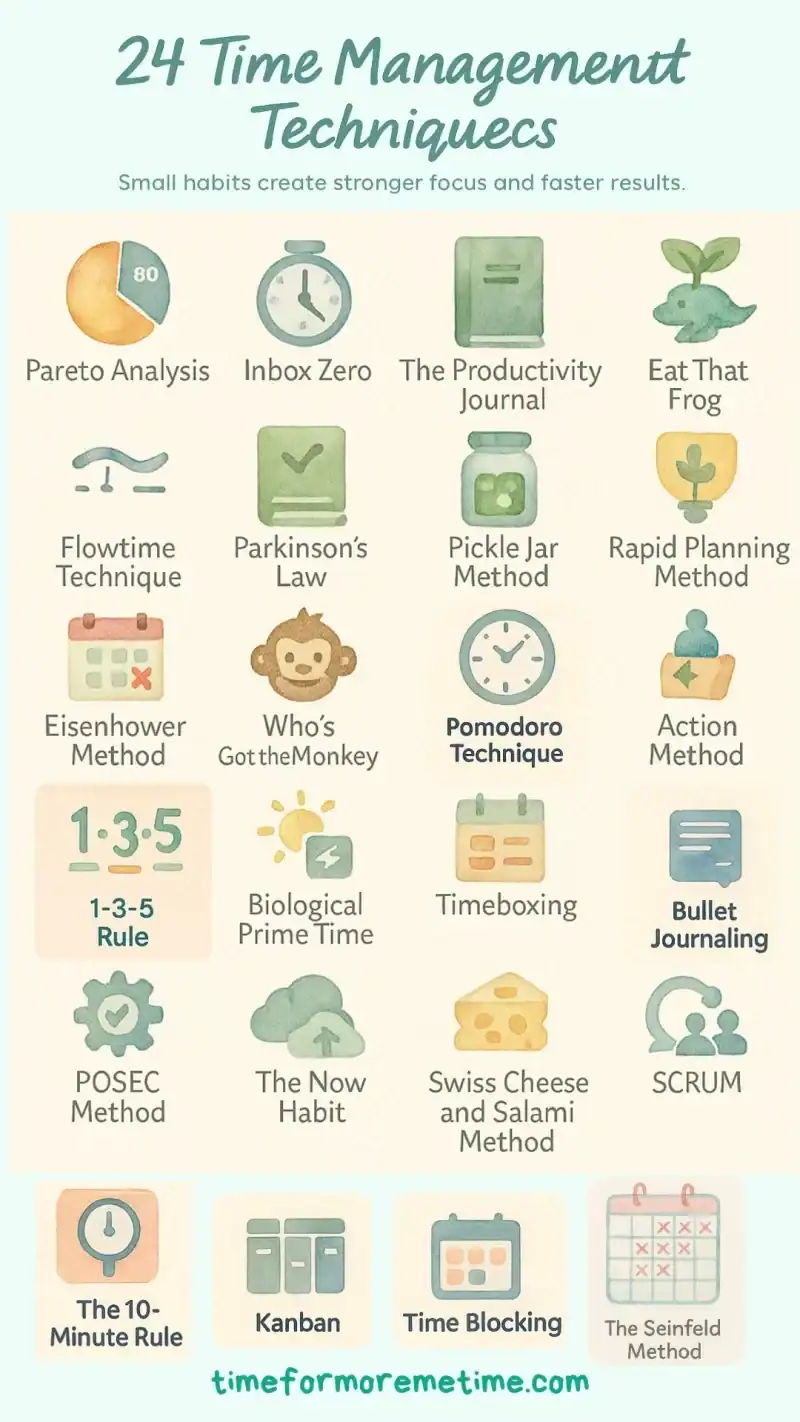
No matter how hard you try, it often feels like there’s never enough time in a day. This makes effective time management essential. Studies show that poor time management can lead to increased stress and reduced productivity for millions.
I’ve had my share of days filled with nonstop work, yet I often felt unaccomplished. While balancing a full-time job and my online side business, I regularly stayed up past midnight, only to find I wasn’t moving closer to my goals. Eventually, I realized that true productivity doesn’t come from working harder, but from applying effective time management techniques that maximize every hour.
Let me share some of the time management strategies I’ve learned and used, which can help you stay focused, organized, and in control of your schedule. Let’s get started!
1. Pareto Analysis
Pareto analysis is a method for identifying the small number of causes (the vital 20%) that produce the majority of effects (about 80%) so you can focus efforts where they matter most. To use it, list and measure problems or tasks, rank them by impact or frequency, calculate cumulative contribution, and target the top items (the critical 20%) for improvement.
In my experience tracking tasks, I found that writing generated most of my income while taking under half my time, so concentrating on that high-value work noticeably increased productivity.
2. Inbox Zero
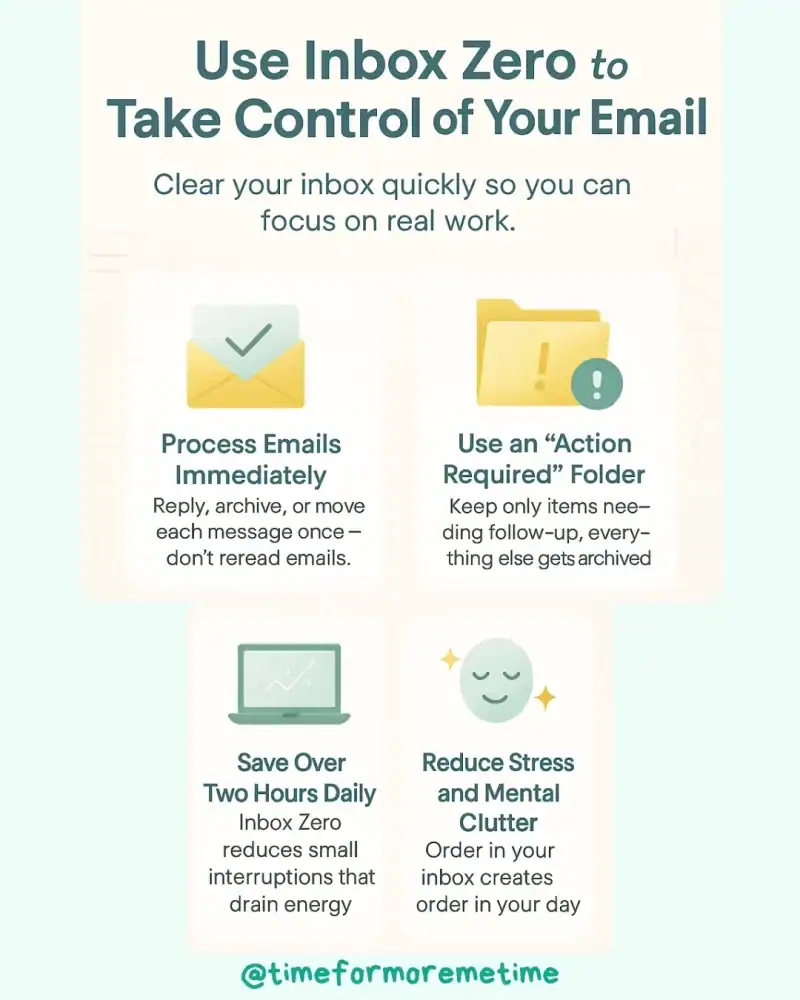
Inbox Zero is a method for regularly clearing or organizing your email so your inbox stays empty or easily manageable. To use it, process messages immediately by replying, archiving, deleting, or moving them to an “Action Required” folder and schedule brief regular times to maintain that flow.
When I adopted this system I cut distractions and reclaimed over two and a half hours a day for meaningful work.
3. Pomodoro Technique
The Pomodoro Technique is a time-management method that uses short, focused 25-minute work intervals followed by brief breaks to sustain concentration. To get started with it, set a 25-minute timer for focused work, take a 5-minute break after each Pomodoro (and a longer 15–30 minute break after four), and repeat while tracking completed intervals.
I found it kept my focus steady during long writing sessions and helped me avoid burnout. Also, I found out that research shows it can boost focus by 15–25%, reduce fatigue by around 20%, and improve motivation, making it easier to stay productive without feeling drained.
4. The 10-Minute Rule
The 10-Minute Rule is a guideline that says if a task will take ten minutes or less, do it immediately instead of postponing it. To take advantage of this rule, identify small tasks, start and complete those that take less than 10 minutes right away, and apply the same 10-minute starting approach to larger tasks to build momentum.
With this, I realized that that beginning intimidating projects for just ten minutes often led me to continue working past that threshold and finish more than I expected.
5. Flowtime Technique
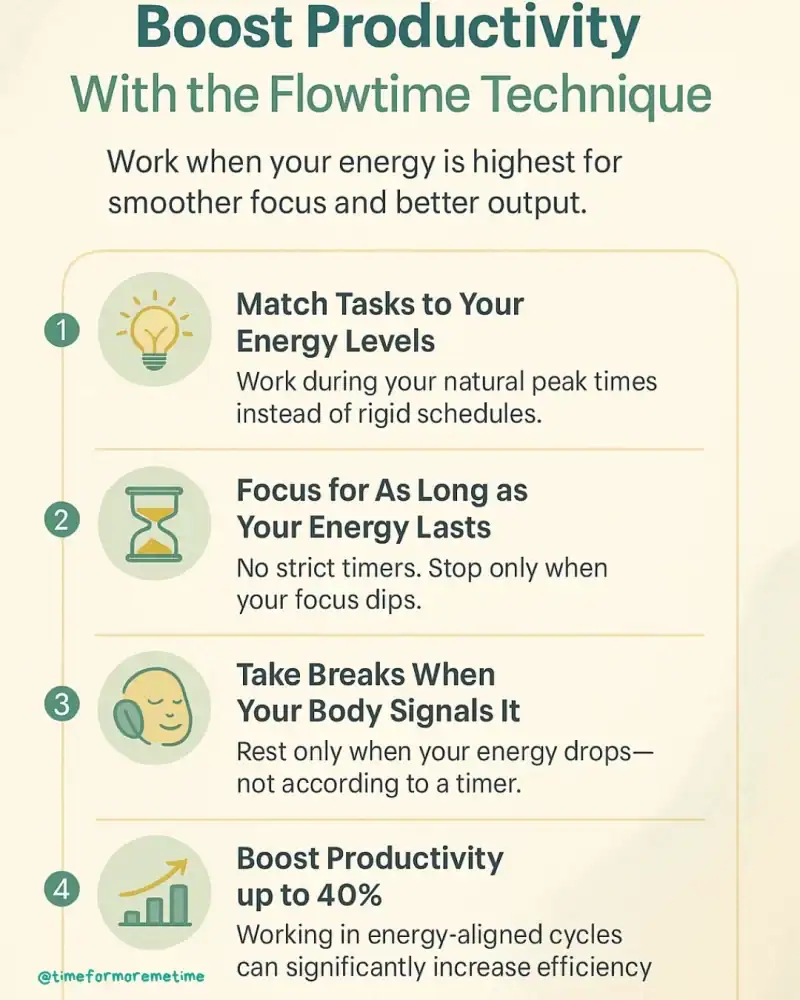
The Flowtime Technique is a time-management method where you work uninterrupted for as long as you naturally remain focused, then take a break when your concentration declines. To get started with it, begin a work session without a strict timer, note when focus starts to wane, take a break, and align subsequent sessions with your natural energy peaks.
I discovered that scheduling deep work during my most productive times and letting sessions run until I lost focus significantly boosted my efficiency. Working in energy-aligned cycles can enhance productivity, although it requires self-awareness to know when to stop without strict timers.
6. Parkinson’s Law
Parkinson’s Law is the principle that work expands to fill the time available for its completion. To get into using this law, set shorter, fixed deadlines or timeboxes for tasks to force focus and reduce unnecessary scope, then work within those limits to complete the task.
I experienced this when shortening a full-day deadline allowed me to finish the same report much faster and with less procrastination.
7. The Productivity Journal
The Productivity Journal is a practice of recording how you spend your time and reflecting on what helps or hinders productivity. You can start with logging daily tasks and time spent, reviewing entries to identify inefficiencies and priorities, and adjusting your schedule based on those insights.
Keeping a daily journal increased my awareness, improved my prioritization, and reduced time wasted.
8. Eat That Frog
Eat That Frog is a strategy of tackling your most difficult or important task first each day to build momentum. To ‘eat that frog,’ identify the highest-impact task each morning, do it before anything else, and protect that time from interruptions.
I used this approach for large projects and found that completing the hardest task early made the rest of my day far more productive. Remember that, prioritizing high-impact tasks can boost daily productivity by up to 20%. Initially, it may feel daunting, but over time, it becomes easier.
9. The Seinfeld Method
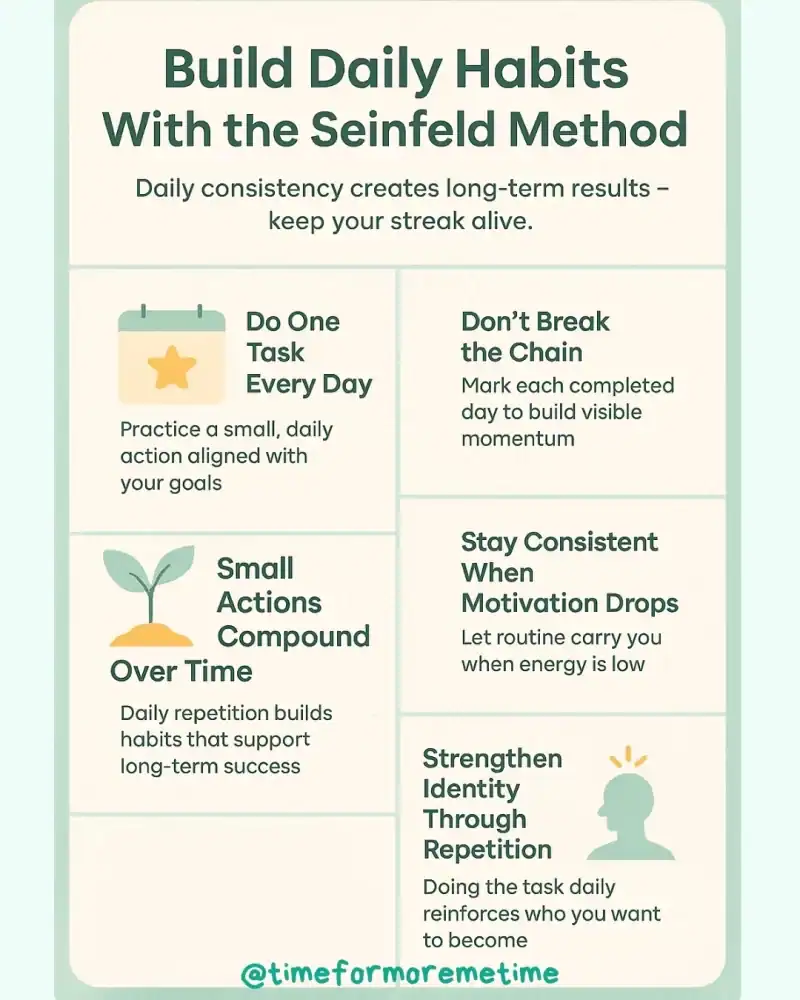
The Seinfeld Method is an approach for building consistent daily habits by doing a small task every day to create momentum. To get into it, choose one daily habit, perform it each day and mark progress on a calendar (don’t break the chain), and maintain consistency even when motivation wanes.
I often used it to write daily for my blog and gradually built a strong, lasting routine.
10. Who’s Got The Monkey
Who’s Got the Monkey is a delegation principle that helps prevent taking on others’ responsibilities so you can focus on higher-priority work. To make full use of this method, identify tasks others can own, assign clear responsibility and expected outcomes, and follow up as needed instead of doing the work yourself.
Whenever I was handling tasks others could do, I always make sure to delegate them and gained time for strategic projects.
11. Pickle Jar Method
The Pickle Jar Method is a prioritization technique that fits your biggest priorities (“rocks”) into your schedule before smaller tasks. To get started, list your most important tasks, schedule those rocks first, then fill remaining time with smaller “pebbles” and “sand.”
I rely on the pickle jar method when overwhelmed and found tackling significant tasks first made the day more manageable and less stressful.
12. Rapid Planning Method
The Rapid Planning Method (RPM) is a goal-focused planning system that links actions to clear outcomes and purpose. To utilize this method, define the specific outcome you want, list why it matters, and create the concrete actions required to achieve it with deadlines.
I applied RPM to side projects and found breaking goals into outcome-driven steps made progress faster and less confusing.
13. Eisenhower Matrix
The Eisenhower Matrix is a task-management tool that sorts tasks by urgency and importance into four quadrants to guide what to do, schedule, delegate, or delete. To make the most of the matrix, list tasks, assign each to a quadrant (urgent/important, important/not urgent, urgent/not important, neither), then act accordingly.
I used this when my to-do list was unmanageable and sorting tasks into quadrants helped me focus on what truly mattered. By the way, a study of 500 employees found this method improves focus and efficiency, with every user reporting they feel in control of their workload most days of the week. Note that accurately defining tasks for proper categorization is essential to minimize wasted effort.
14. Biological Prime Time
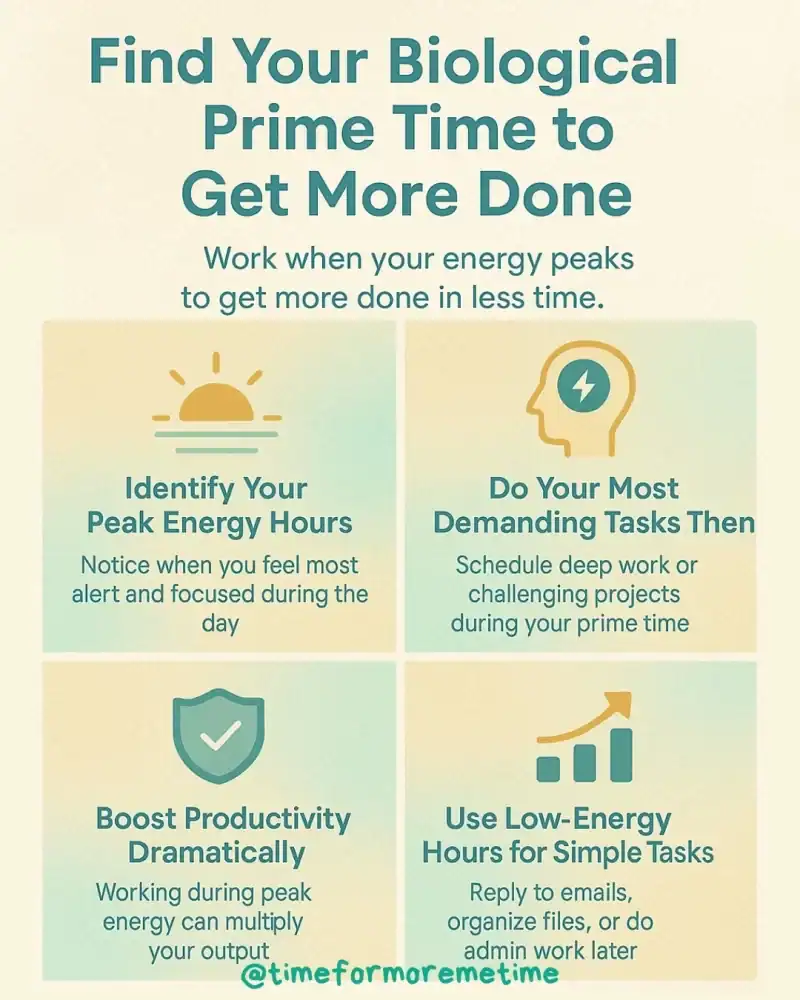
Biological Prime Time is the concept of working during your personal peak-energy periods to maximize effectiveness. To begin, track your energy across the day to identify peak windows, schedule your most challenging tasks in those windows, and protect that time from interruptions.
I discovered mid-morning was my prime time and scheduling hard work then dramatically improved my output.
15. Kanban
Kanban is a visual workflow system that organizes tasks into columns (e.g., To Do, In Progress, Done) to expose flow and bottlenecks. To take advantage of its benefits, create a board with columns, add tasks as cards, move cards across columns as work progresses, and limit work-in-progress to keep flow steady.
I adopted Kanban for multiple projects and found it clarified priorities and revealed bottlenecks quickly.
16. Action Method
The Action Method is a productivity system that breaks goals into concrete Action Steps, Backburner Items, and References so work moves forward. To make full use of it, define clear outcomes, list actionable next steps with owners and deadlines, move non-urgent ideas to the backburner, and store references separately.
I used the action method to advance large projects and found it kept me focused on the next concrete action.
17. Time Blocking
Time Blocking is a scheduling technique that segments your day into dedicated blocks for specific activities to eliminate context switching. To utilize this technique, assign fixed blocks on your calendar for focused work, meetings, email, and breaks, and treat each block as protected time.
I time-blocked my days to reduce chaos and was able to concentrate on one task at a time.
18. Timeboxing
Timeboxing is a method that allocates a strict, fixed amount of time to a task and stops when the timer ends to prevent scope creep. To use it, set a clear time limit for a task, work until the timer finishes, then review progress and adjust future boxes as needed.
Timeboxing helps me stop tasks from dragging on and allow me to feel lots of increases in focus and efficiency.
19. 1-3-5 Rule
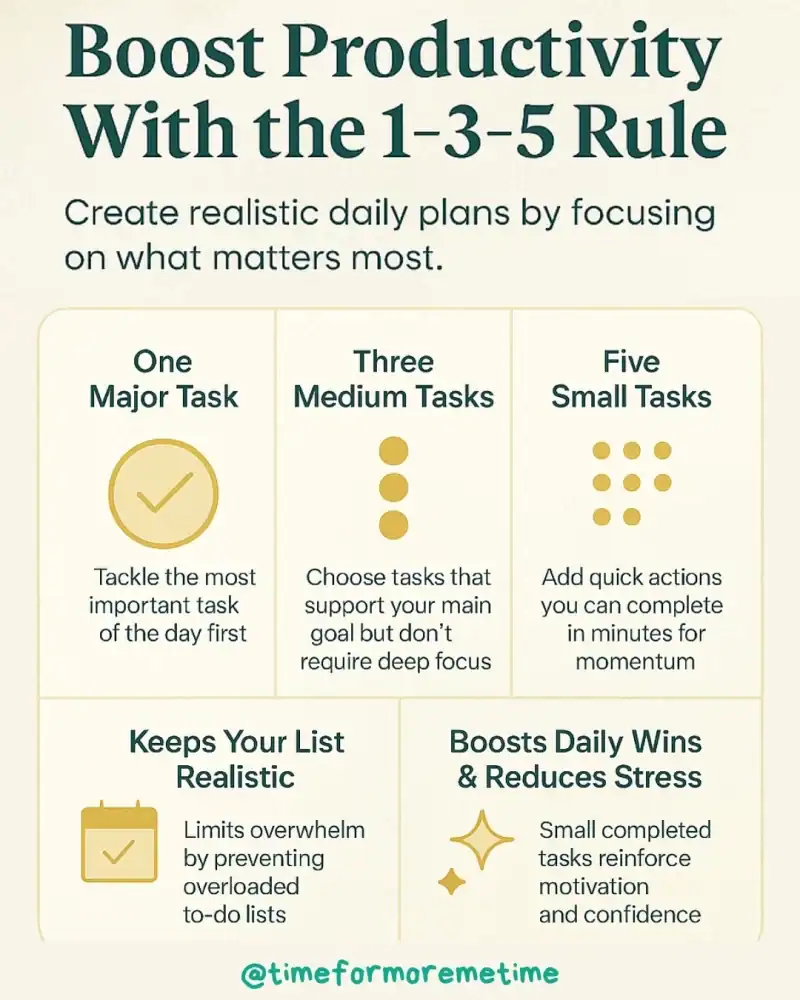
The 1-3-5 Rule is a to-do list guideline that limits each day to one big task, three medium tasks, and five small tasks so your plan stays realistic and focused. If you want to use it, pick one major objective, three mid-size items, and five quick tasks each morning, then work through them in priority order and adjust as needed.
I found breaking my day into these chunks reduced stress and helped me make steady progress.
20. Bullet Journaling
Bullet Journaling is a flexible analog system that combines to-do lists, scheduling, and notes in a single notebook for organized tracking. Seems great, right? So, to use it, create rapid-entry bullets for tasks, events, and notes, maintain an index and monthly/weekly logs, and migrate unfinished items to keep priorities current.
Switching from digital apps to a Bullet Journal helped me declutter my workflow and better visualize progress.
21. POSEC Method
The POSEC Method is a productivity framework that organizes tasks into Prioritize, Organize, Streamline, Economize, and Contribute to focus effort on what matters most. To get your feet wet with it, sort your responsibilities into those five categories, act first on prioritized high-impact items, then organize and streamline remaining tasks, economize low-value work, and reserve time for contribution.
I use this method when juggling side projects and responsibilities and it helped me concentrate on high-impact activities while managing lesser tasks efficiently.
22. The Now Habit
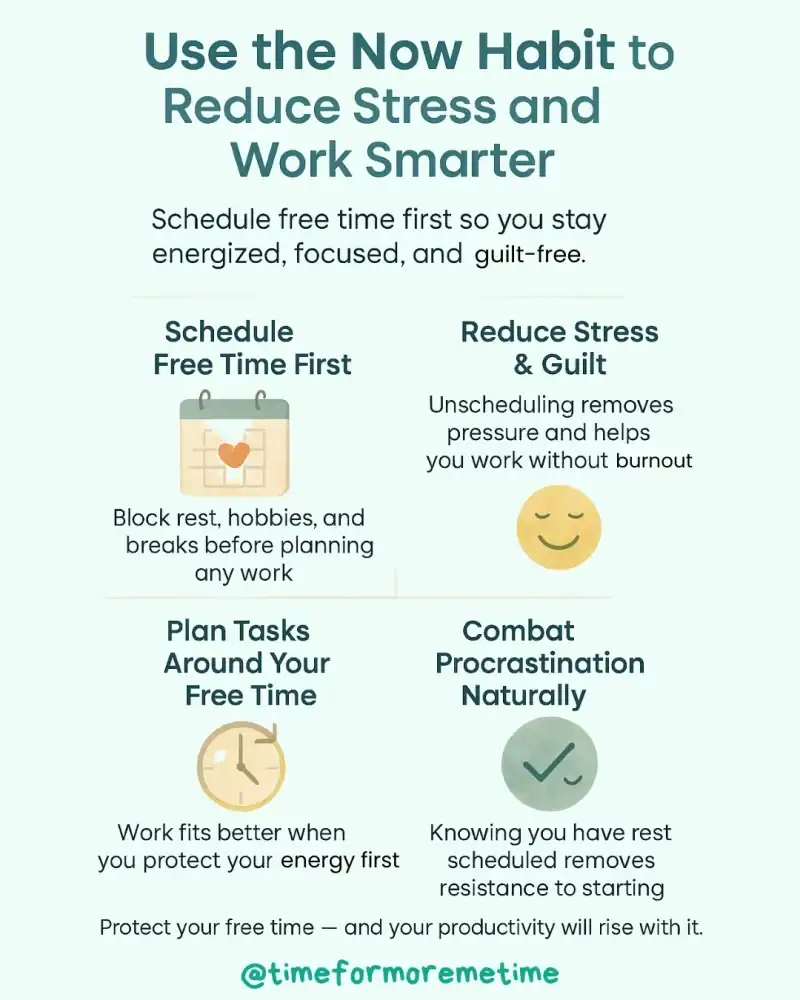
The Now Habit (Unscheduling) is a productivity approach that schedules free time first to reduce guilt, stress, and procrastination. To start incorporating this into your life, block regular, guilt-free leisure or hobby periods on your calendar, then plan work sessions around those protected breaks to stay energized and focused.
I started unscheduling when I felt guilty for not working, and deliberately reserving relaxation time made my work sessions more productive and less stressful.
23. Swiss Cheese And Salami Method
The Swiss Cheese/Salami Method is a strategy for breaking large projects into many small, manageable pieces so progress becomes easy and consistent. You can use it to divide a big task into bite-sized actions you can complete in short increments (even 10–20 minutes) and chip away at the project a little at a time.
I typically do this to difficult side projects and found that small, steady efforts removed overwhelm and led to steady completion.
24. SCRUM
SCRUM is an agile project-management framework that organizes team work into short, timeboxed sprints with regular reviews and daily stand-ups to maintain focus and adaptability. To do SCRUM, create a product/backlog of tasks, plan work into 1–4 week sprints, hold daily brief check-ins, and run sprint reviews and retrospectives to inspect and adapt.
I use this framework on team projects and found sprints and daily syncs kept the team aligned, productive, and responsive to change.
Which Time Management Technique Is Best For You?
Implementing structured time management techniques can greatly enhance productivity and significantly reduce stress. I’ve personally utilized many of these methods, and there are various options to choose from. While some techniques may seem similar, the primary differences lie in how tasks and time are visualized. I’m confident you’ll find one that suits your needs.
If you found this information helpful, consider subscribing to my blog. You can also follow me on social media and check out my YouTube channel. Thank you!
Sources
- PubMed. (2025). Assessing the Efficacy of the Pomodoro Technique in Enhancing Anatomy Lesson Retention During Study Sessions: A Scoping Review. pmc.ncbi.nlm.nih.gov/articles/PMC12532815/
- Enterprise. (2025). Finding Your Work Rhythm: How to Optimize Your Energy Levels. blog.enterprisecoworking.com/finding-your-work-rhythm-how-to-optimize-your-energy-levels
- Week Plan. (2024). High Impact Tasks (HITs) – Boost Productivity and Efficiency. weekplan.net/high-impact-tasks/
Acuity Training. (2025). Time Management Statistics: Original Independent Research. acuitytraining.co.uk/news-tips/time-management-statistics-research/