


Have you ever worked all day but felt like you barely made any progress toward your goals? Do you find yourself spending a lot of time on tasks without seeing significant results? If this sounds familiar, you’re not alone.
In this post, I’ll introduce you to the Pareto principle—a straightforward yet powerful concept that explains how 80% of your results often come from just 20% of your efforts. Let’s get started!
What Is The Pareto Principle
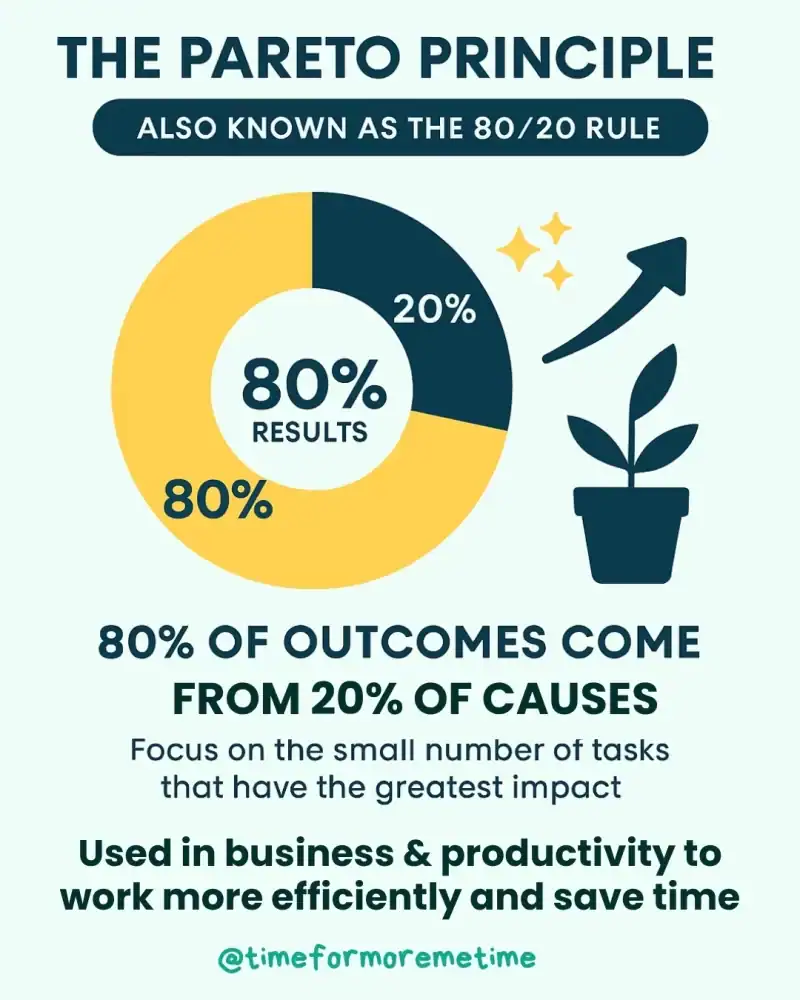
The Pareto principle, or the 80/20 rule, is a time management concept stating that 80% of your results come from 20% of your efforts. Named after Italian economist Vilfredo Pareto, who noted that 80% of Italy’s land was owned by 20% of the population, this principle applies to various areas, including business and productivity.
While not a strict law, it highlights that a small portion of your work, clients, or habits often drives the majority of your outcomes. For example, 20% of your daily tasks may generate 80% of your results, or 20% of your customers may account for 80% of your revenue.
The main goal of the Pareto principle is to help you identify what matters most, allowing you to focus your time and energy on high-impact tasks. While it doesn’t instantly save time, it helps you use your time more intentionally by identifying and prioritizing what truly matters. Over time, this can reduce waste, minimize distractions, and improve productivity.
Today, the Pareto principle is widely used in business strategy, project planning, and personal productivity, helping you become more efficient and save time.
Why Should You Use The Pareto Principle
The Pareto principle is ideal for people who feel busy but unproductive. It forces you to pause and ask: What’s actually making a difference? Instead of trying to do everything, it encourages you to focus on the tasks, habits, or people that yield the most meaningful outcomes.
Here are five key reasons to use the Pareto principle in your time management:
- Maximize Impact: By focusing your energy on the most effective 20% of your efforts, you can achieve more in less time. This doesn’t mean working fewer hours; it means spending more time on what really matters, leading to better results and greater time efficiency.
- Eliminate Time-Wasters: This helps you identify tasks that yield the least results for your effort. By reducing or delegating these time-wasters, you can focus on work that truly matters, freeing up hours in your day that would otherwise be lost to busywork.
- Make Better Decisions: It provides a clear framework for prioritizing projects, clients, and responsibilities. By helping you cut through indecision and over analysis, it reduces the time spent second-guessing and boosts confidence in your choices.
- Improve Focus: Instead of multitasking, you concentrate on what drives the most value, whether it’s in your work, health, or personal life.
- Avoid Burnout: When you stop spreading yourself thin, you reduce stress and reserve your energy for what truly matters. You make the most of the limited time you have.
Applying the Pareto principle shifts your mindset from being busy to being effective—something many people overlook in their daily routines.
How To Start Using The Pareto Principle
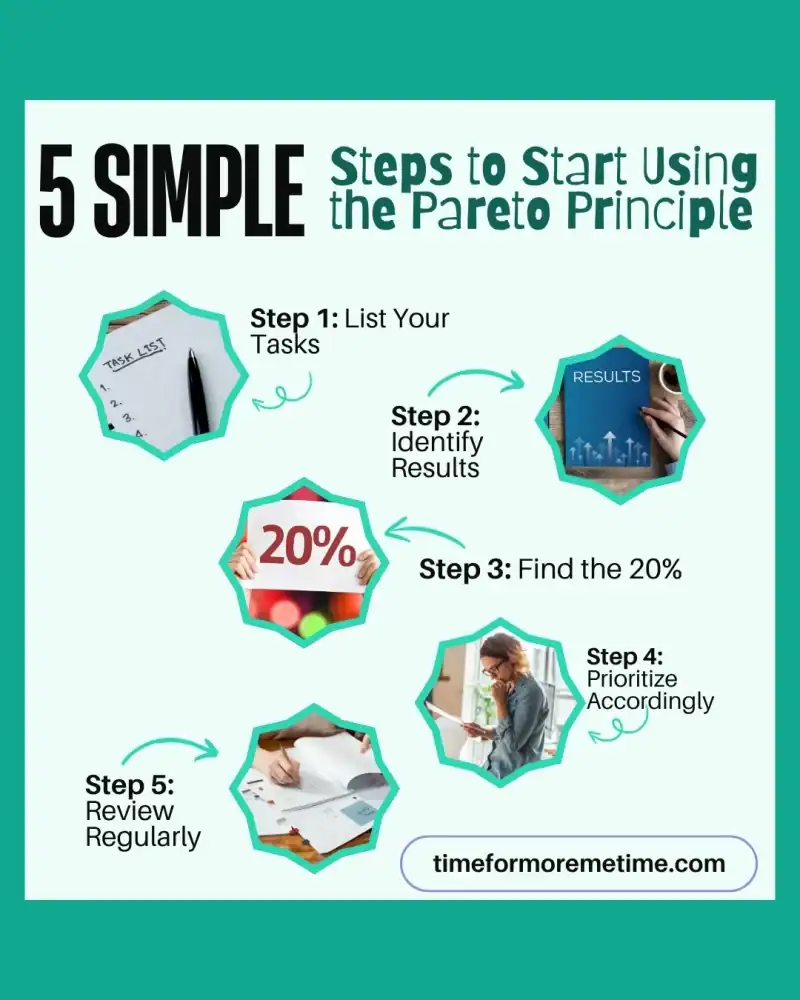
You can start applying the Pareto principle in any area of life. Here’s a step-by-step guide to help you use it effectively:
- List Your Tasks: At the end of the day or week, write down everything you worked on.
- Identify Results: Look at what outcomes came from those tasks. What moved the needle the most? What didn’t?
- Find the 20%: Highlight the top tasks that contributed to the majority of your results. These are your high-impact activities.
- Prioritize Accordingly: Restructure your schedule to spend more time on high-impact tasks and reduce or delegate low-impact ones.
- Review Regularly: Repeat this process on a weekly or monthly basis to stay aligned and continuously improve your time allocation.
To make the most of the Pareto principle for saving time, start by tracking how much time you spend on different tasks and comparing that to the results they produce. This will help you determine what to focus on. For instance, if a task takes two hours each day but results in little progress, you can adjust your routine or find ways to automate it, allowing you to reclaim valuable time.
You can apply this approach to your workday, exercise routine, marketing strategy, or almost anything else. The key is to regularly reflect and make adjustments. And over time, this approach can help you streamline your workload, reduce unnecessary tasks, and reclaim hours that would otherwise be lost to low-impact work.
What Are The Drawbacks Of The Pareto Principle
While the Pareto principle is a useful framework, it’s not perfect. Here are a few limitations and challenges to consider:
- Difficult to Measure: It’s not always obvious which tasks are part of the vital 20%, especially when results are delayed or hard to track.
- Temptation to Ignore Small Tasks: Some small tasks still need to be done—like emails or admin work—even if they don’t directly lead to big results.
- Not Always a Perfect Ratio: The 80/20 split is a general rule, not a hard formula. In some cases, the ratio might be 70/30 or 90/10.
- Can Overlook Team Efforts: In collaborative settings, applying this principle too rigidly might undervalue supportive roles or background work.
- Requires Regular Reevaluation: What’s effective today may not be tomorrow. Tasks that were high-value last month may shift as priorities change.
Understanding these drawbacks helps you use the Pareto principle wisely—as a guide for focus, not a strict rule.
Conclusion
The Pareto principle is a proven strategy that helps you achieve more by focusing on the few actions that deliver the greatest results. This approach boosts productivity, reduces overwhelm, and enables significant progress toward your goals, ultimately leading to more efficient use of your time and saving you time in the long run.
To get more helpful tips, subscribe to our blog, follow us on social media, and check out our YouTube channel for cool and insightful videos.
Sources
- Photos: Unsplash: Avi Richards