



In today’s fast-paced world, effective time management is essential for achieving more, reducing stress, and enhancing our quality of life. This post will cover key time management skills, common challenges and their solutions, and techniques to improve these skills.
Additionally, I’ll highlight useful apps and tools to aid your journey toward better organization. Whether you’re a student, busy professional, or entrepreneur, you’ll find actionable advice to boost your productivity. Let’s get started!
Understand Time Management
Time management involves making intentional choices about how we allocate our time to achieve specific goals while maintaining focus. It’s like having a toolbox filled with skills such as goal-setting, prioritization, and planning.
Improving time management is essential for enhancing study sessions and effectively managing urgent tasks. Contrary to the belief that good time management means being busy or rigidly scheduled, it’s about working smarter and being flexible, including scheduling breaks.
The benefits of effective time management include:
- Increased Productivity: By being strategic with your time, you accomplish more tasks and goals, leading to career advancements and higher earnings.
Reduced Stress: Effective planning and prioritization help eliminate last-minute panic, allowing you to meet deadlines with ease.
Better Work-Life Balance: Working efficiently frees up time for personal interests, helping to prevent burnout while boosting productivity.
Understanding time management enables you to use it effectively. To simplify this process, it’s important to learn the key principles for mastering your time, which will be covered next.
Know The Key Principles Of Time Management

We’ve all had days filled with tasks that leave us feeling overwhelmed. To manage your time effectively, it’s crucial to prioritize tasks by distinguishing between what is urgent and what contributes to your long-term goals.
One effective prioritization tool is the priority matrix, which sorts tasks by urgency and importance. A 2025 review of 86 peer-reviewed studies found that prioritization was moderately associated with stronger workplace performance.
For example, an urgent client deadline belongs in the urgent-and-important section, while a future project can be scheduled for later. This approach helps you focus on high-value work, plan less urgent tasks, and reduce time spent on distractions.
In addition to prioritization, setting SMART goals can significantly enhance your time management:
- Specific: Define clear, precise goals.
Measurable: Establish metrics to track your progress.
Attainable: Set realistic goals to ensure success.
Relevant: Align goals with your values and aspirations.
Time-bound: Set deadlines to create urgency.
Another important principle is the Pareto Principle, which states that 80% of your results come from just 20% of your efforts. Focus on identifying and prioritizing the tasks that provide the highest return on your time investment.
You can also improve your time management by eliminating time-wasters and incorporating buffer time to handle unexpected changes. Regular breaks are essential for staying energized and preventing mental fatigue.
Additionally, maintain flexibility in your planning to adapt to unforeseen circumstances. By integrating these key principles, you can boost your productivity and achieve your goals more effectively.
Learn Effective Time Management Techniques
Numerous productivity techniques have emerged over the years, each promising to enhance focus and achievement. Here are some effective methods to consider for improving your time management skills:
- Time Blocking: Treat your schedule as a valuable resource by dedicating specific hours to particular tasks. Schedule meeting blocks for deep work to prevent interruptions.
- Pomodoro Technique: Work in short intervals, typically 25 minutes, followed by 5-minute breaks. This structure helps train your brain to focus intensely, boosting efficiency and productivity.
- Eat That Frog: Inspired by Mark Twain’s quote, this technique involves tackling your most daunting task first thing in the morning. Research supports this idea. One 2020 study with 2,013 participants found that starting with the hardest task can help build self-efficacy, or confidence in your ability to handle the work.
- Getting Things Done (GTD): This method focuses on establishing a reliable system for managing tasks and projects. By transferring to-dos from your head to a structured list with deadlines, you can reduce mental clutter and stress.
- Batch Processing: Group similar tasks together and complete them in one go. This minimizes context switching and allows you to maintain focus, making your workflow more efficient.
Learning these techniques can help you discover the best ways to improve your productivity and time management.
Utilize Time Management Tools

Enhance your time management skills by leveraging technology through various apps and online tools. Replace bulky paper calendars with digital options like Google Calendar and Outlook Calendar. Explore their features, such as recurring events, customizable notifications, and color coding, to streamline your workflow.
For task management, consider visually appealing tools like Asana, Trello, and ClickUp. My team and I found ClickUp particularly useful during our first few months of operations.
To track how you spend your time, use a time tracking tool. A 2020 Microsoft study of 81 software developers found that tracking time can help measure productivity patterns. That means knowing where your time goes, where it helps you spot patterns, compare effort with results, and make better productivity decisions.
While digital tools are valuable, don’t underestimate the power of writing things down. Consider bullet journaling, jotting tasks on notepads, or using classic notebooks to track your long-term goals. For digital note-taking, you might try Bullet Journals or Notion.
Defeat Time Management Challenges
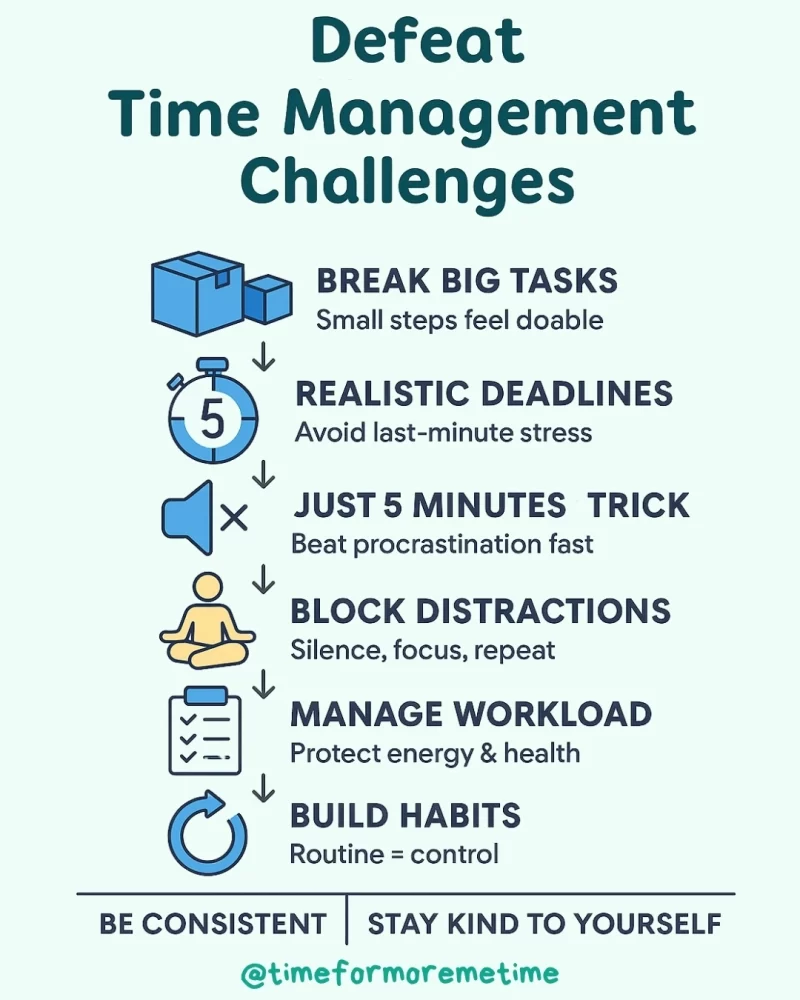
Numerous roadblocks can hinder effective time management, often leading to procrastination and guilt. To overcome these challenges, start by identifying your procrastination triggers, such as fear of failure, feeling overwhelmed, or boredom.
- Break Down Large Tasks: Split big projects into smaller, manageable steps to make them feel less daunting.
- Set Realistic Deadlines: Create achievable deadlines that are not overly tight.
- Use the ‘Just 5 Minutes’ Technique: Commit to working on a task for just five minutes to help overcome initial resistance.
- Minimize Distractions: Establish a dedicated workspace, turn off notifications, and use noise-canceling headphones to block out distractions and maintain focus.
- Manage Your Workload: Set realistic work hours and prioritize self-care to prevent burnout and illness, which can waste time.
- Create Effective Habits: Develop a consistent daily or weekly schedule to support your time management goals. Consider using planning tools like Evernote and delegate tasks when possible.
- Reflect and Adjust Regularly: Periodically review your time management strategies to optimize your approach. Identify tasks that take up too much time and reduce activities that don’t add value. consume excessive time and cut down on activities that don’t add value.
To fully overcome time management challenges, stay consistent. Make time management a habit by incorporating it into your daily routine. Be kind to yourself; productivity may vary, but persistence is essential.
Tailor Time Management
Time management strategies can vary greatly from person to person, as everyone has different needs. The key is to identify the skills that suit your current situation.
- For Students: College life involves balancing lectures, study sessions, extracurricular activities, and social life. A task-based time management system can help create a schedule that accommodates all these responsibilities.
- For Professionals: In the corporate world, start by assessing how you currently spend your time and identifying areas for improvement, especially in shared workspaces where distractions are common. Time-tracking apps can reveal common distractions, helping you gain more free time and a sense of accomplishment.
- For Entrepreneurs: Effective time management is crucial to avoid stress from juggling priorities. A workplace study of 71 employees found that time management training increased people’s sense of control over their time and lowered perceived stress.
Ultimately, effective time management is about being intentional with how you spend your time, not just cramming more tasks into your day. Find what works for you, stick with it, and watch your productivity and well-being improve.
Conclusion
Mastering time management skills can transform your life in today’s busy world. Whether you’re facing deadlines, seeking a better work-life balance, or aiming to reduce stress, adopting effective strategies is essential. Explore various techniques, leverage technology, and experiment to find a productivity system that suits you.
If you learned something here, consider subscribing to my site, following me on social media, and checking out my YouTube channel. Thank you!
Sources
- Photos: Pexels: JESHOOTS.com
- Frontiers in Education. (2025). Boosting productivity and wellbeing through time management: Evidence-based strategies for higher education and workforce development. https://www.frontiersin.org/journals/education/articles/10.3389/feduc.2025.1623228/full
- ScienceDirect. (2020). To build efficacy, eat the frog first: People misunderstand how the difficulty ordering of tasks influences efficacy. https://www.sciencedirect.com/science/article/abs/pii/S0022103120303723
- arXiv. (2020). Mind the gap: On the relationship between automatically measured and self-reported productivity. https://arxiv.org/abs/2012.07428
- Taylor & Francis. (2010). Time management training and perceived control of time at work. https://www.tandfonline.com/doi/abs/10.1080/00223980.2010.496647