


Dropshipping used to be seen as an easy way to make money. But only one or two out of ten stores succeed long-term. That’s why you’re here, hoping to start strong and make it work.
I tried dropshipping in 2018 while working a second job at a hospital. It added about 5% to my income but took almost all my free time. I realized it isn’t passive and can’t replace your day job until much later, so I stopped after a year.
You need focus, structure, and smart choices to succeed. I’ve refined my approach since then, and now I can help you start better. So, in this guide, you’ll learn how to start dropshipping—from choosing a niche and finding suppliers to marketing and growing your store, even with little or no money. Let’s get started.
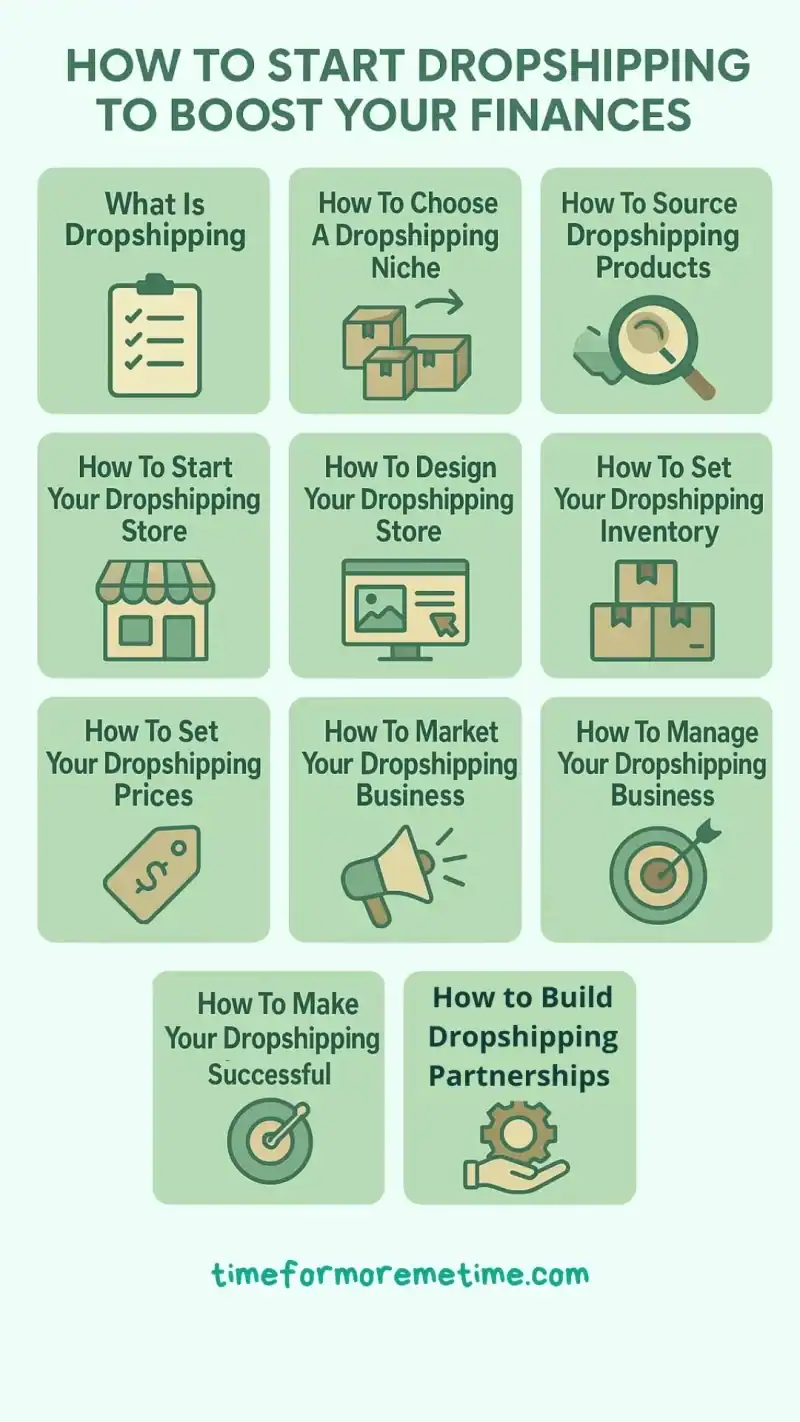
1. What Is Dropshipping
Dropshipping is a simple retail setup where you sell products without holding any inventory. You take the customer’s order, pay the supplier, and the supplier ships the item directly to the buyer. As I mentioned before, I did this in 2018, when discussions about dropshipping were hot on the internet and social media.
Dropshipping is popular because it’s low-cost and flexible. You don’t need to buy or store products in advance; you only purchase items after a customer orders them. I loved that I could manage my store anywhere with WiFi, even during lunch breaks at work.
Dropshipping can work, but launching a store does not guarantee lasting income. Among US private-sector businesses that opened in 2013, 79.6% remained open after one year, 50.6% after five years, and 34.7% after ten years. These figures measure business survival rather than profitability and do not apply only to dropshipping.
Still, they show why beginners should treat dropshipping as a long-term business. This means you should conduct product research, work with reliable suppliers, pursue effective marketing, and manage costs carefully rather than expecting quick results.
2. How To Choose A Dropshipping Niche
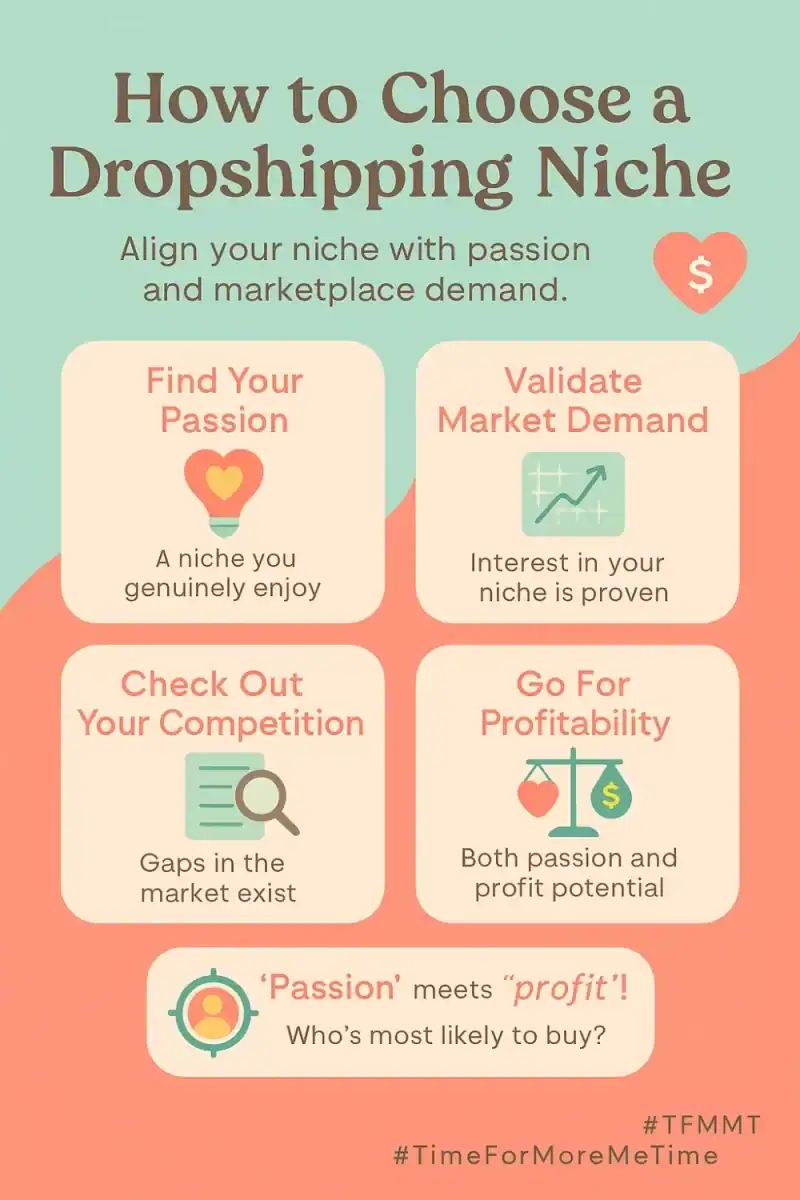
Your niche defines the core of your business. Instead of trying to sell a wide range of products, focus on a specific market. This allows you to reach the right audience and differentiate yourself. For example, I chose to sell clothing and gym equipment because I find shirts easy to sell, and I’m passionate about fitness, particularly MMA.
Selecting a dropshipping niche is crucial for your success. Keep in mind that only about 1.5% of dropshipping stores earn over $50,000 per month, highlighting how rare true success is. Entering a crowded niche without a unique angle makes it even more difficult to succeed.
Consider what you are passionate about and what people are already seeking. When your niche aligns with your interests and meets existing demand, you’ll stay motivated and improve your chances of success.
3. How To Source Dropshipping Products
Your supplier decides how well your business runs. Good suppliers mean happy customers, while bad ones lead to delays and complaints. I once picked a cheap supplier without testing and got five returns in one week. A bad way to start a business.
Finding a good supplier is difficult, to be honest. Over 84% of dropshippers say finding reliable suppliers is their biggest challenge. This shows how important supplier research is. The more you test and verify, the fewer problems you’ll face later
Not all suppliers are the same. You should look for one that fits your business well. Pay attention to how fast they ship, whether they ship locally or internationally, how they handle returns, and how well they communicate.
Always think ahead. Before you even start testing a supplier, check their reviews and talk to other dropshippers to find out about good options.
4. How To Build Dropshipping Partnerships
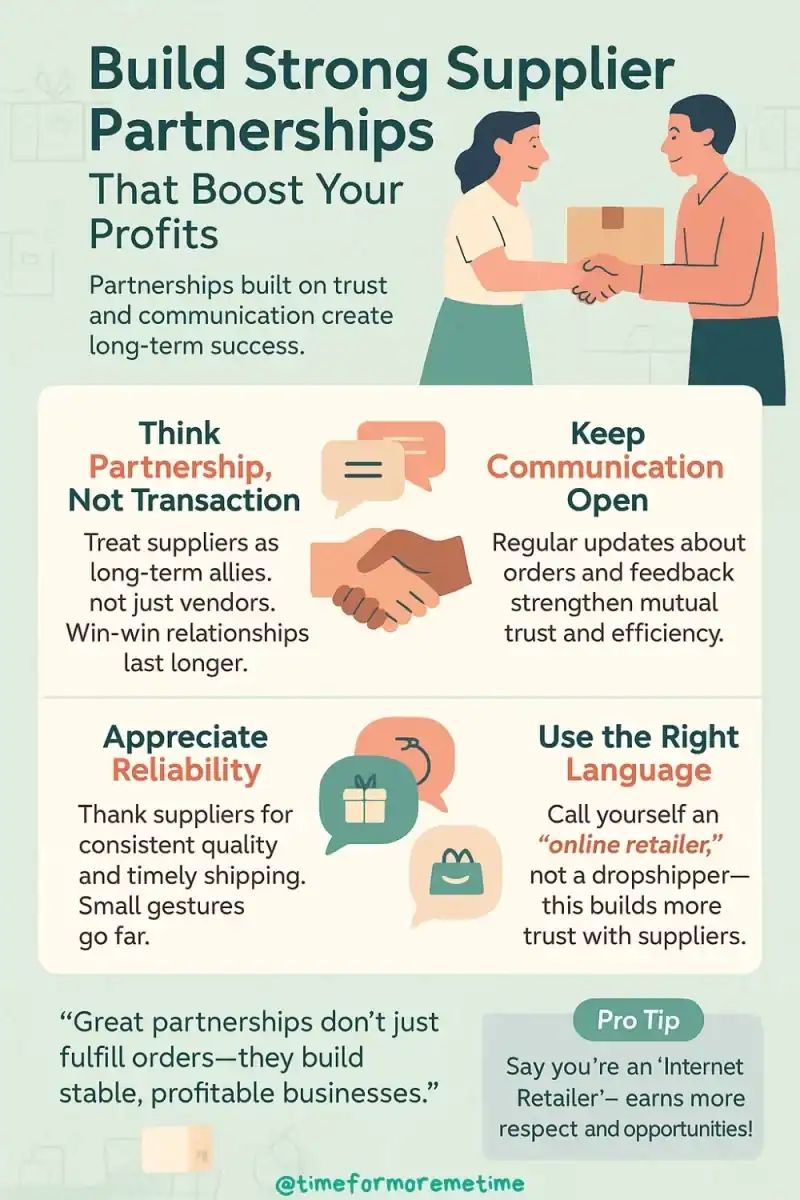
After you find a good supplier, it’s important to build a strong partnership with them. Treat them as allies rather than just vendors. For instance, when I expanded my shirt collection, I talked to my supplier privately and negotiated small discounts. They were happy to agree when I promised to focus on selling and marketing their products.
Treat your supplier as a business partner rather than someone who simply fulfills orders. In a McKinsey survey of more than 100 large organizations, regular supplier collaboration was associated with stronger growth, lower operating costs, and higher profitability.
Communicate regularly, pay on time, negotiate terms both sides can sustain, and recognize dependable service. These habits can reduce delays, protect your profit margin, and give both businesses a reason to keep working together.
By the way, here’s a pro tip: It’s also a good idea not to call yourself a dropshipper when talking to suppliers. Instead, tell them you’re an internet retailer. This description is similar but avoids the negative feelings that many suppliers have about dropshipping because of failed experiences with others.
5. How To Start Your Dropshipping Store
Your online store is your business home. Choose a platform that fits your skills, budget, and comfort level. I used Shopify because it was easy to set up, while a friend preferred WooCommerce for its flexibility.
The right e-commerce platform can make daily operations much easier. If you’re not into coding, a plug-and-play option saves time and headaches. The goal is to get your store running smoothly, not to build from scratch.
Also, decide on what matters more: simplicity or control? Once you pick the right platform, focus on listing your first products and making your store look professional.
6. How To Design Your Dropshipping Store
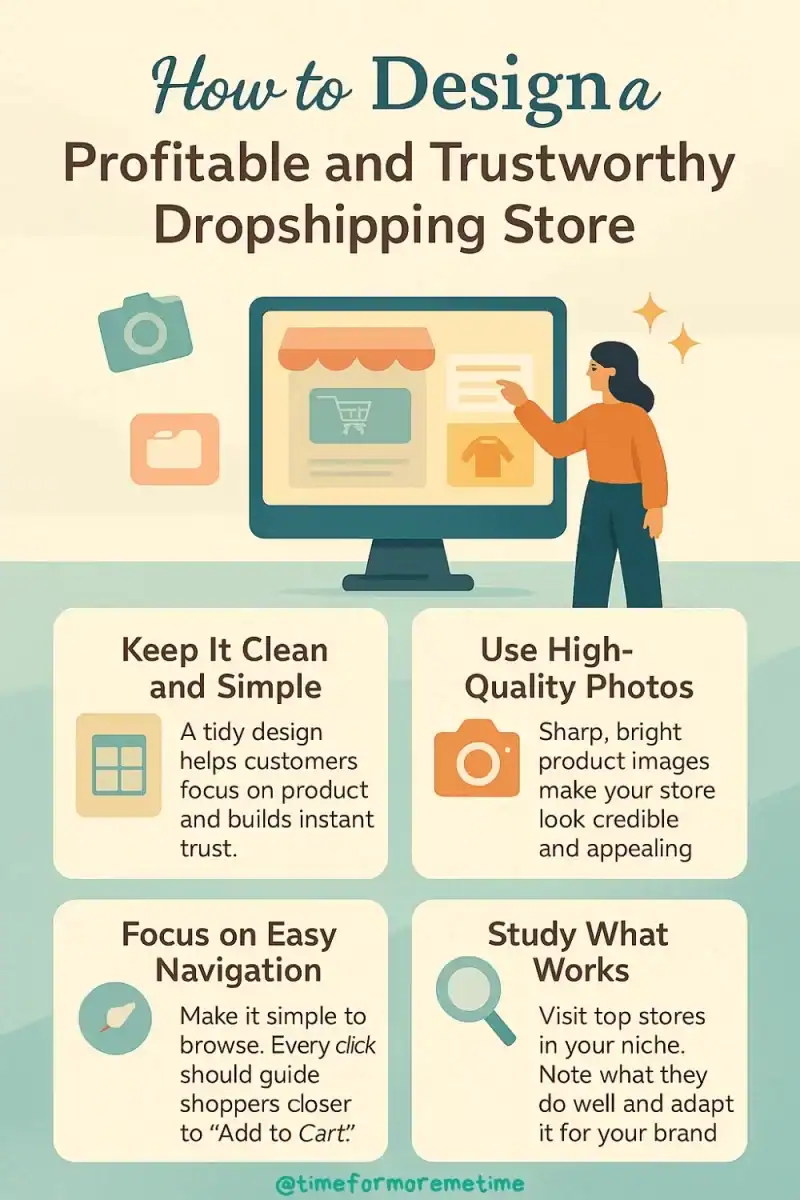
A clean, well-designed store can shape whether visitors feel confident enough to buy. A 2025 study of 344 online shoppers in China found that website appearance was linked to stronger buying interest, even more than product quality, in the study’s results. For your business, that suggests clear menus, sharp photos, and useful product descriptions can help move shoppers closer to checkout.
For example, if 1,000 people visit your store and 20 buy, your conversion rate is 2%. If a redesign helps four more visitors complete a purchase, you gain four extra orders from the same traffic. The study does not guarantee an increase, but it shows that store design can influence buying decisions.
Visit other online stores in your niche. See what they do well, note what they don’t, and apply what works. Make your store easy to browse so customers click “Add to Cart” without hesitation.
7. How To Curate Your Dropshipping Inventory
When curating your dropshipping inventory, it’s essential to have a clear and focused list of products. This kind of list performs much better than a random assortment of items. Choose products that align with your niche and resonate with your audience. I removed many generic items and noticed more engagement right away.
Having a product list focused on your niche helps build a stronger brand and clearer messaging that customers can trust. Look through your catalog and ask yourself if each item fits your brand and if your audience would care about it. Keep the products that answer “yes,” and get rid of the rest. This focus will lead to better results.
8. How To Set Your Dropshipping Prices
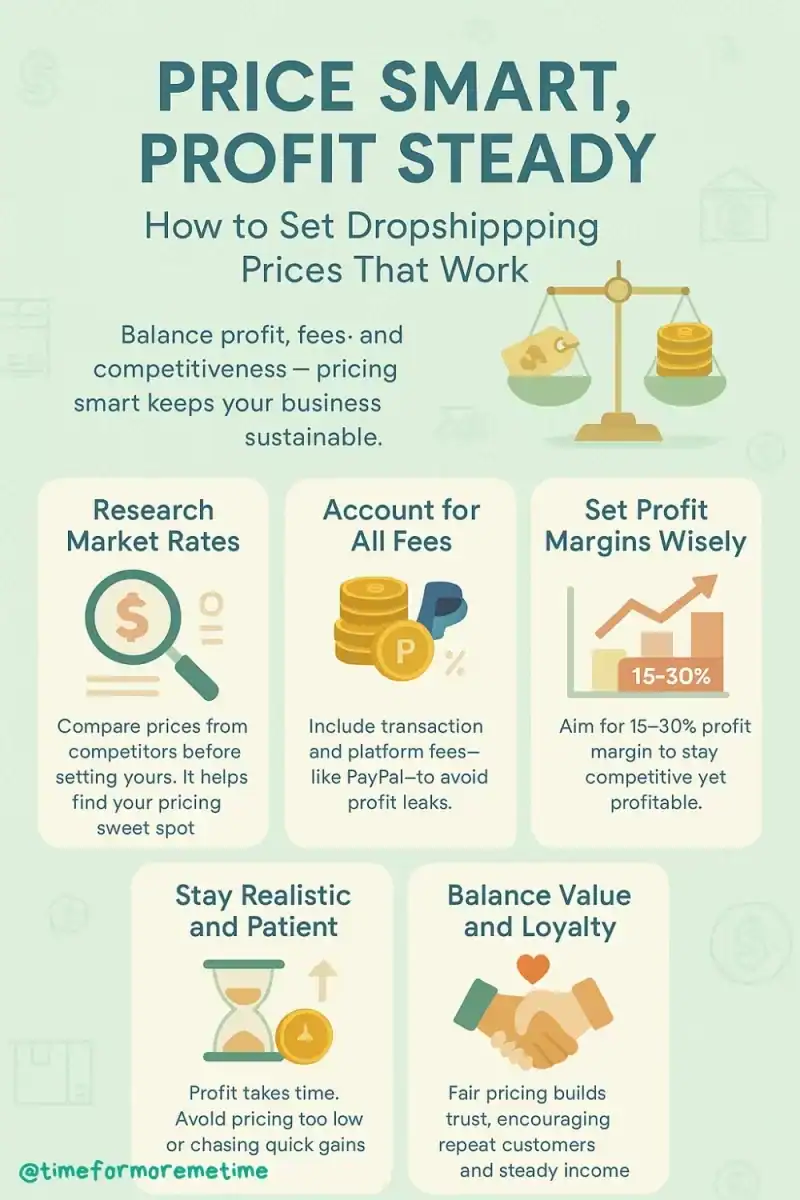
Finding the right prices involves balancing profit with being competitive. Look at what other sellers charge, take all your fees into account, and then set a price that allows you to earn money. I realized early on that PayPal’s fees could quickly eat into my profits.
I aimed for profit margins between 15% and 30% when setting my prices. This helped me sell my products while covering my costs, but I still didn’t make as much money as I wanted.
Keeping everything in balance—fees, expenses, and pricing—is crucial. This balance was one reason I took a break from dropshipping. Sometimes, even with hard work, you might end up with lower profits. However, maintaining this balance can encourage customers to return and give you a consistent revenue stream.
The main point is to avoid being greedy or impatient about making money. At the same time, don’t set your prices so low that it hurts your business. Remember, it often takes time for a business to become truly profitable.
9. How To Market Your Dropshipping Business
Your store won’t make sales if no one is visiting it. You need to focus on marketing through SEO, social media, ads, and emails to attract traffic and build trust. For example, I once used Facebook ads that tripled my store visits in just one week.
In my experience, most dropshipping traffic often comes from platforms like Facebook and Instagram, so having strong visibility on these sites can set successful stores apart from those that struggle. If Facebook and Instagram aren’t the right fit for you, find out where your potential customers spend their time and focus your marketing efforts there.
Marketing works better when your message reaches people who are likely to care about the offer. Nielsen analyzed 82 campaigns across 15 brands and found that audience reach explained 68% of the differences in sales results. In one campaign example, poorly targeted ads returned only $0.25 for every $1 spent, while the strongest audience-focused group returned $2.60. This does not prove targeting caused the entire increase, since the message and offer also affect performance.
Still, the numbers show why focusing your budget on suitable customers can produce better results than promoting your business everywhere.
10. How To Manage Your Dropshipping Business
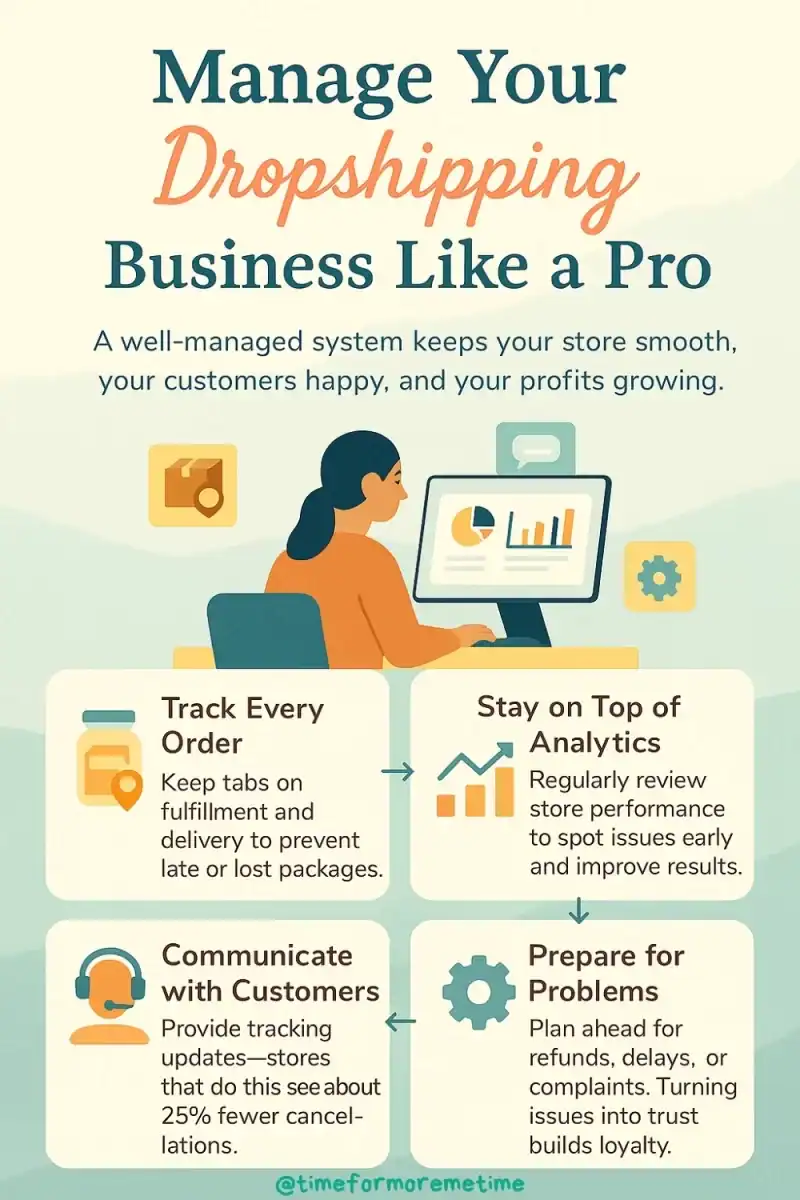
Having efficient systems is crucial for keeping your business running smoothly. You are responsible for handling orders, tracking shipping, and managing customer service while your supplier takes care of shipping. I once neglected to track my analytics and ended up losing sales during checkout.
Customers may lose confidence when they cannot see an order’s status or know when it should arrive. A 2025 McKinsey survey found that roughly half of US shoppers check tracking information to make sure their delivery is still expected on time. Small delays may cause less frustration when retailers communicate clearly, since 85% of respondents did not view an order as seriously late if it arrived only one or two days after the promised date.
Strong communication also matters after delivery problems occur. UPS reports that more than 90% of shoppers who receive an easy return experience would consider purchasing from the same retailer again. Create clear procedures for delays, complaints, returns, and refunds so customers receive timely updates and know what will happen next.
11. How To Make Your Dropshipping Business Successful
During my time in the business, my main strategy was to build momentum through planning. This approach helped me go beyond basic dropshipping. Instead of just listing items, I created a launch calendar, surveyed my audience, built email sequences, and treated my supplier like a partner.
By doing this, I saw an 18% increase in my month-on-month growth. The difference is clear: you’re not just setting up a store and hoping for the best. Instead, you’re actively building momentum and planning product launches, treating marketing as something that will happen, not something that might happen. Being in this proactive position puts you in the minority, and that’s a positive thing.
Conclusion
Your entrepreneurial spirit has brought you this far. Now, let research, planning, and discipline help you go even further. As a dropshipper, you need to be dedicated and resilient, as it can take several years for your earnings to match what you’d make in a regular job. I can promise you that.
If you enjoy this kind of content, make sure to subscribe to my blog, follow me on social media, and check out my YouTube channel. Thanks!
Source
- Photo: Pexels: Saravut Vanset
- Bureau of Labor Statistics. (2024). 34.7 percent of business establishments born in 2013 were still operating in 2023. https://www.bls.gov/opub/ted/2024/34-7-percent-of-business-establishments-born-in-2013-were-still-operating-in-2023.htm
- Do Dropshipping. (2026). The 40 most insightful dropshipping statistics in 2026. https://dodropshipping.com/dropshipping-statistics/
- ZIK Analytics. (2026). 60 important dropshipping statistics for 2026. https://www.zikanalytics.com/blog/dropshipping-statistics/
- McKinsey & Company. (2021). Overcoming barriers to multitier supplier collaboration. https://www.mckinsey.com/capabilities/operations/our-insights/overcoming-barriers-to-multitier-supplier-collaboration
- PLOS ONE. (2025). Exploring drivers of modern Hanfu purchase in digital commerce: A mixed-methods perspective. https://journals.plos.org/plosone/article?id=10.1371/journal.pone.0337228
- Nielsen. (2022). How audience-based reach metrics in-flight can boost ROI. https://www.nielsen.com/insights/2022/how-audience-based-reach-metrics-in-flight-can-boost-roi/
- McKinsey & Company. (2025). What do US consumers want from e-commerce deliveries? https://www.mckinsey.com/industries/logistics/our-insights/what-do-us-consumers-want-from-e-commerce-deliveries
- UPS. (n.d.). How smarter returns management can lead to retail success. https://www.ups.com/us/en/customized-shipping-logistic-services/retail-store-shipping-logistic-solutions/returns-management